The biggest misconception in maritime decarbonization today: "Burning green ammonia in a conventional 2-stroke engine with a diesel pilot injection solves the emissions challenge."
The engineering reality tells the exact opposite story. Adding pilot fuel (5% to 15% marine gas oil) to forcibly initiate ultra-slow ammonia ignition is not an optimization, it masks the mechanical limitations of a traditional crankshaft.
The result is a combustion cycle that hits an ecological and thermodynamic dead end:
1. Toxic Emissions and Greenhouse Penalties Persist
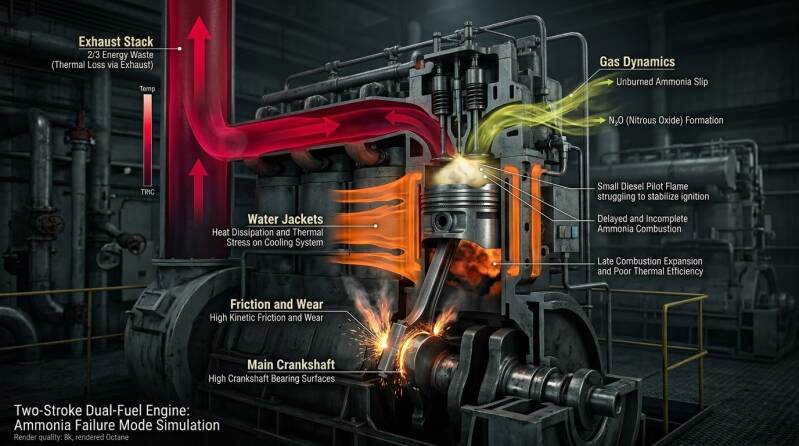
The diesel pilot does not merely maintain a continuous fossil CO2 and particulate footprint; the clash between high-speed diesel flame propagation and sluggish ammonia kinetics causes severe incomplete combustion. The direct consequences:
• High ammonia slip escaping unreacted;
• Dangerous spikes in nitrous oxide (N2O), a greenhouse gas 273 times more potent than CO2.
The problem simply shifts from carbon dioxide to severe toxic emissions, demanding massive, expensive Selective Catalytic Reduction (SCR) aftertreatment systems.
2. Two-Thirds (2/3) of Fuel Energy Is Lost as Waste Heat
A mechanical crankshaft forces the piston downward immediately after Top Dead Center (TDC), precisely when slow-burning ammonia requires constant-volume dwell time at peak compression. This causes massive thermodynamic degradation:
• Exhaust blowdown loss: Slow reaction kinetics push peak heat release deep into the expansion stroke, dumping valuable chemical energy straight out the stack.
• Cylinder wall dissipation: Prolonged flame exposure transfers immense thermal loads into the cooling jackets.
• Mechanical friction: Piston side-thrust, wrist pins, and connecting-rod bearings consume the remaining shaft power.
Over 65% of the fuel's chemical enthalpy is destroyed as unrecoverable heat, simply to force a 21st-century zero-carbon molecule to conform to 19th-century mechanical kinematics.
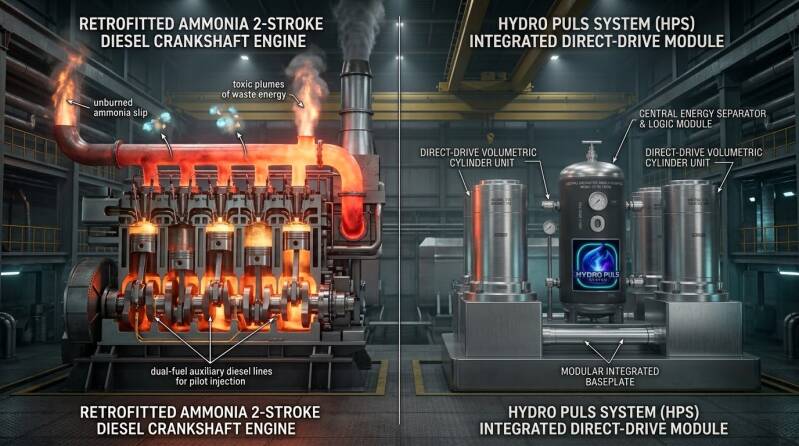
True maritime transition does not require a fossil torch inside an obsolete crankcase. It demands crankless, direct fluid mechanics (such as the Hydro Puls Direct-Drive platform). Only by tailoring piston motion and dwell time to chemical reaction rates can we eliminate both the fossil pilot crutch and the massive thermal waste.
Stop forcing new chemistry into ancient mechanics.
#MaritimeEngineering #GreenAmmonia #Decarbonization #Shipping #HPDD #HydroPulsDirectDrive #Thermodynamics #CleanTech #MarinePropulsion #AlternativeFuels