How HPDD & The Atomic Eraser Disrupt Battery Cell Manufacturing Economics 🔋⚡️
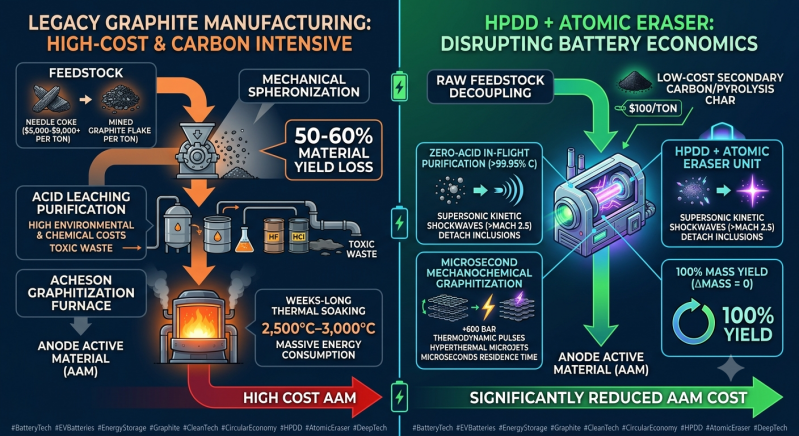
Graphite is by far the largest raw material component in an EV battery by weight (~50–70 kg per vehicle). Yet, battery-grade synthetic graphite has remained one of the most carbon-intensive and expensive bottlenecks in the battery supply chain, trading at $5,000 to $9,000+ per metric ton.
The cost isn't driven by the carbon itself, it is driven by archaic manufacturing physics:
1. Weeks-long thermal soaking at 2,500°C–3,000°C in Acheson graphitization furnaces.
2. 50–60% material yield loss during mechanical spheronization of natural graphite flakes.
3. Severe environmental and chemical costs associated with acid leaching (HF/HCl) to reach the required >99.95% purity.
The HPDD + Atomic Eraser train bypasses these constraints, reshaping the battery cost equation:
• Raw Feedstock Decoupling (Tire Char to Anode Precursors):
Instead of relying on premium needle coke or mined natural flake graphite, the unit takes low-cost secondary carbon/pyrolysis char ($100/ton) and transforms it directly into high-value turbostratic carbon and synthetic nano-graphite.
• Zero-Acid In-Flight Purification (>99.95% C):
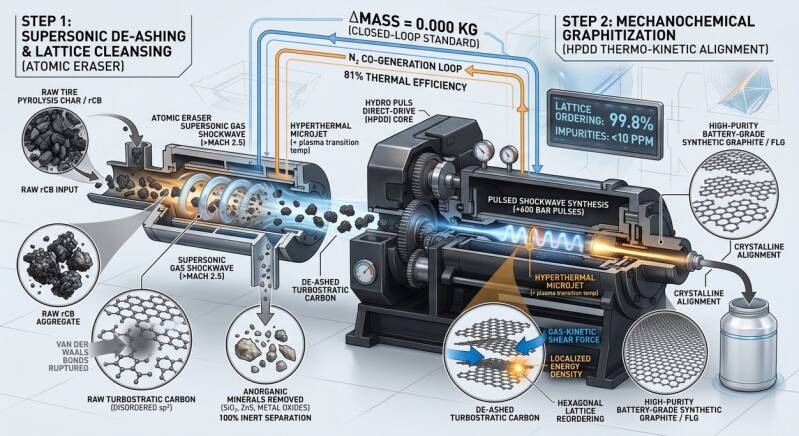
Supersonic kinetic shockwaves (>Mach 2.5) detach mineral inclusions (SiO2, ZnS, iron oxides) mechanically in flight. Cell manufacturers obtain ultra-pure, sub-micron precursor feeds without toxic chemical leaching, water treatment burdens, or milling-media contamination.
• Microsecond Mechanochemical Graphitization:
By applying +600 bar thermodynamic pulses paired with hyperthermal microjets under an inert co-generated N2 atmosphere, the HPDD core reorders the sp2 carbon sheets in microseconds. This eliminates the massive energy footprint and weeks of furnace residence time typical of legacy graphitization.
• 100% Mass Yield (ΔMass = 0):
Unlike conventional mechanical shaping where over half the feedstock is ground into useless dust, the hermetically closed loop retains 100% of the active carbon mass.
The Manufacturing Impact:
By crushing precursor processing costs, slashing graphitization energy demands by orders of magnitude, and eliminating chemical purification lines, the HPDD-Atomic Eraser platform creates a viable pathway to substantially compress anode active material (AAM) costs, unlocking cheaper, localized, and truly circular battery cell production.
#BatteryTech #EVBatteries #EnergyStorage #Graphite #CleanTech #CircularEconomy #HPDD #AtomicEraser #DeepTech #ProcessIntensification #BatteryManufacturing