Commercial fusion power will not be won in the plasma core alone, the true battle for a bankable plant (Q_electric > 1) takes place in the machine room.
While magnetic confinement physics sets milestone after milestone, Balance-of-Plant (BoP) parasitics remain the primary obstacle to net-positive grid delivery. Tens of megawatts are continuously consumed by heavy cryogenic compressors, sluggish rotary steam turbines, and oversized auxiliary pumps.
The Hydro Puls Direct-Drive (HPDD) platform tackles these operational bottlenecks simultaneously across three critical operational pillars:
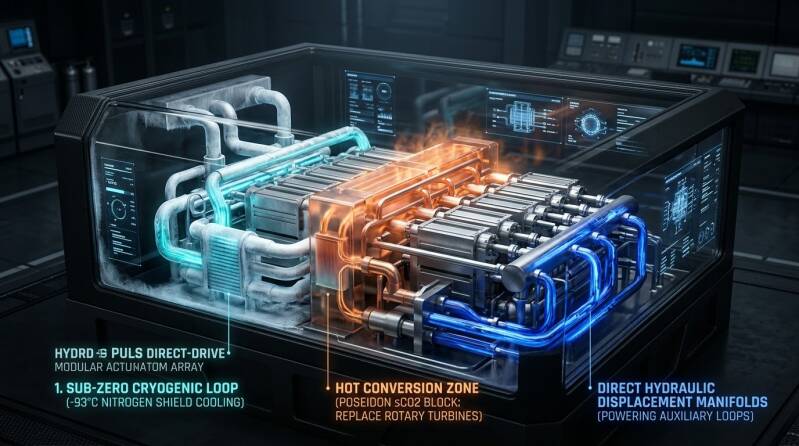
1. Cryogenic Cooling as an Integrated Byproduct (Cold Side)
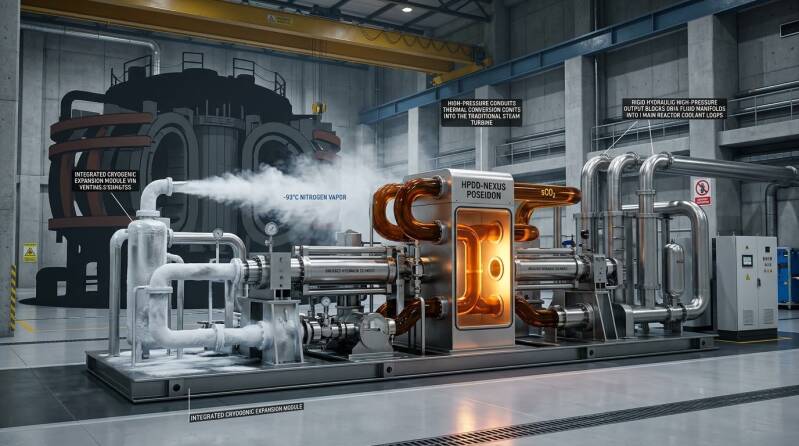
Maintaining superconducting magnets at operational temperatures places massive electrical demands on conventional cryoplants. Through controlled linear nitrogen expansion, HPDD delivers continuous process cooling down to -93°C (180 K). Utilizing this sub-zero stream for thermal radiation shields cuts warm chiller electrical draw by over 50%, freeing up an estimated 7 to 9 MW of continuous plant power.
2. HPDD-NEXUS & POSEIDON (sCO2): Dynamic Thermal Conversion (Hot Side)
Forcing high-enthalpy fusion energy through an obsolete Rankine steam turbine creates severe inertia, aerodynamic losses, and vulnerability to rapid plasma transients.
The HPDD-NEXUS and POSEIDON configurations (tailored for supercritical CO2 / sCO2) replace the rotary turbine with direct volumetric linear expansion via crankless opposed pistons. Stroke-by-stroke control on a millisecond timescale dynamically absorbs thermal shifts without throttling losses.
3. Direct Hydraulic Work for Pumping and High-Pressure Delivery
Instead of routing power through intermediate generators to drive electric motor pumps, incurring multiple conversion penalties, the HPDD core generates direct hydraulic fluid displacement. This enables stiff, compact fluid circulation and pressure buildup for secondary coolant loops and auxiliary circuits within a hermetically sealed boundary (ΔMass = 0.000 kg).
By unifying cryogenic relief, advanced sCO2/steam conversion, and direct fluid mechanics into a single architecture, HPDD substantially cuts internal recirculating loads.
That is how scientific fusion facilities transition into economically viable commercial power stations.
#NuclearFusion #HPDD #HydroPulsDirectDrive #FusionEnergy #BalanceOfPlant #DeepTech #sCO2 #Cryogenics #PowerGeneration #CleanTech #EnergyTransition