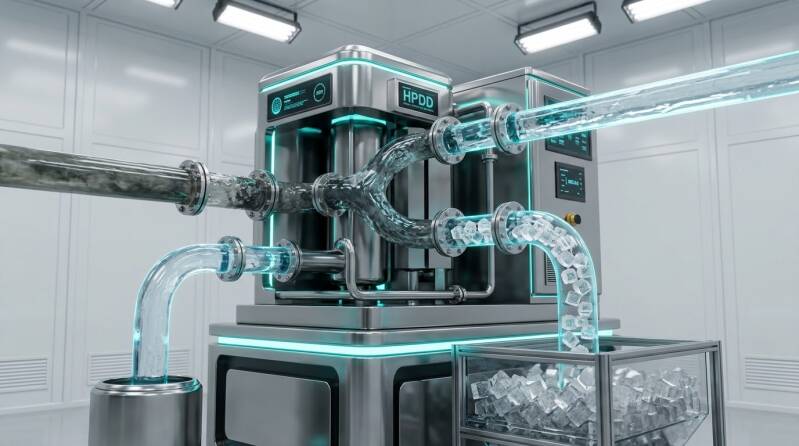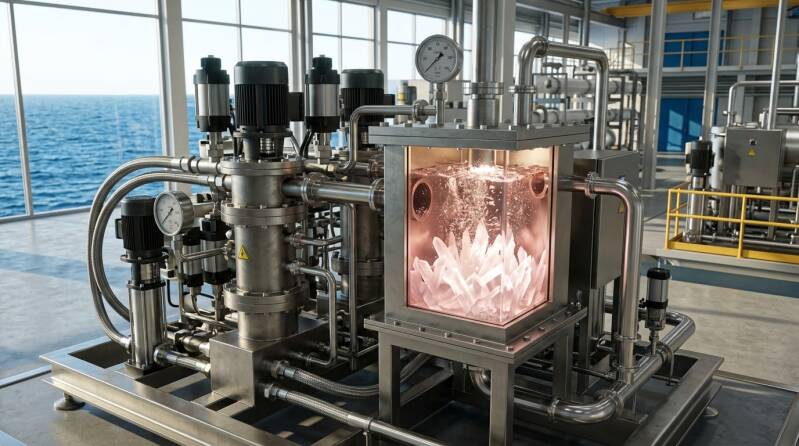
Desalination reject brine is not an environmental liability. It is a liquid potassium mine.
Across the globe, seawater reverse osmosis (SWRO) facilities discharge millions of cubic meters of hypersaline brine back into fragile coastal ecosystems every single day. Simultaneously, global food production remains geopolitically vulnerable and heavily dependent on volatile supply chains for potassium chloride (KCl / Muriate of Potash)—the indispensable "K" in NPK fertilizers.
Through horizontal scalability, the Hydro Puls Direct-Drive (HPDD) platform integrates selective mineral harvesting directly into desalination reject streams:
• Selective Precipitation & Accelerated Kinetics: Direct hydraulic pulsing and acoustic cavitation physics accelerate nucleation rates, enabling the sharp, controlled precipitation of potassium chloride away from sodium chloride and magnesium fractions.
• Energy-Efficient Brine Concentration (ZLD): Conventional thermal evaporators consume enormous amounts of steam and electrical power. HPDD applies direct volumetric compression combined with thermal recovery to drive fractional crystallization at a fraction of the specific energy input.
• Complete Mass Containment (ΔMass = 0.000 kg): The modular skid operates under a hermetically closed mass balance, eliminating secondary chemical waste and fugitive slip.
• Localized Nutrient Autonomy: Coastal and arid regions can convert seawater intake into fresh water, high-purity magnesium nitrate, and potassium chloride on a single integrated site.
Transforming linear brine dumping into on-demand, circular fertilizer production right at the source.
#Desalination #PotassiumChloride #KCl #Fertilizer #CircularEconomy #ZeroLiquidDischarge #HPDD #HydroPulsDirectDrive #CleanTech #ProcessIntensification