HPDD-Nexus: The Thermomechanical Revolution on the Hot Side of Fusion Energy
Direct Volumetric Expansion Replacing the Conventional Steam Turbine
OVERVIEW: SOLVING THE HOT-SIDE EFFICIENCY BOTTLENECK
While HPDD cryogenic nitrogen expansion slashes parasitic cooling loads on the cold side by 20% to 25%, the HPDD-Nexus resolves the largest efficiency bottleneck on the hot side: the 19th-century steam turbine.
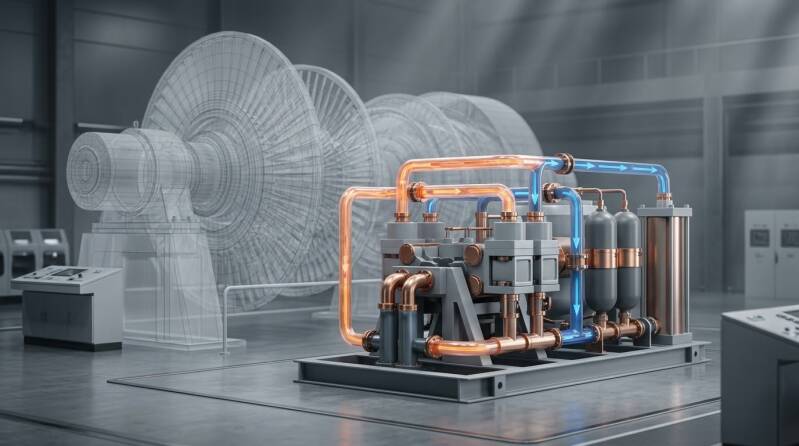
In magnetic confinement fusion systems, routing high-enthalpy thermal output through a traditional Rankine steam cycle creates a critical vulnerability. The HPDD-Nexus replaces this sluggish, turbulent, and maintenance-heavy cycle with direct, crankless linear fluid expansion engineered for extreme thermodynamic stiffness.
WHY THE CONVENTIONAL STEAM TURBINE FAILS IN COMMERCIAL FUSION
Current balance-of-plant designs for fusion power plants routinely specify standard steam turbines. This architecture introduces severe operational penalties that threaten a net-positive energy balance (Q_electric > 1):
- Massive Auxiliary Plant Loads: A traditional steam cycle requires large condensors, vacuum extraction pumps, high-pressure multistage boiler feed pumps, and cooling towers. These balance-of-plant auxiliaries consume tens of megawatts of continuous parasitic power merely to cycle and condense water.
- Inability to Match Plasma Transients and Pulses: Tokamaks and magnetic confinement architectures inherently operate with thermal transients and pulsed profiles. Heavy rotary turbines exhibit massive inertia and tolerate rapid fluctuations poorly. Dynamic load variations induce blade flutter, thermal stress, and erosion, forcing the turbine into inefficient partial-load bypass modes.
- Aerodynamic and Mechanical Leakage Losses: Substantial kinetic energy is continuously dissipated across rotor-stator gaps, aerodynamic blade drag, shaft seals, and mechanical reduction gearboxes.
THE HPDD-NEXUS ARCHITECTURE: DIRECT VOLUMETRIC FLUID POWER
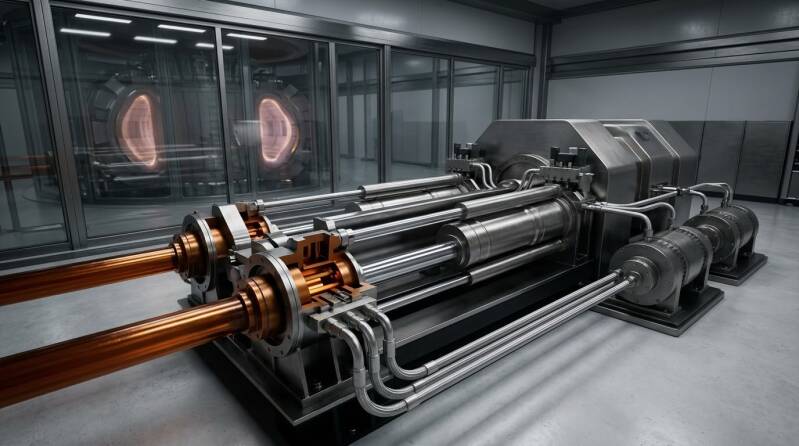
The HPDD-Nexus converts thermal expansion directly into high-pressure hydraulic work using a modular, crankless linear piston array:
- Direct Pressure-to-Hydraulics Conversion: Working fluids or superheated vapor from the reactor blanket and divertor heat exchangers expand directly against the stiff piston faces of the Nexus core. There are no rotary shafts, turbine blades, or reduction gearboxes.
- Millisecond Dynamic Stroke Control: Lacking a rigid mechanical crankshaft, the stroke length, displacement, and expansion rate are electronically modulated per cycle. When plasma thermal output shifts, the Nexus dynamically adjusts volumetric intake without sacrificing thermodynamic efficiency.
- Hermetically Closed Mass Balance (Delta Mass = 0.000 kg): Working fluids remain completely isolated through advanced metal bellows and dynamic separation modules, providing the containment required for nuclear-grade, tritium-safe environments.
THERMODYNAMIC LEVERAGE ON Q_ELECTRIC
By making power extraction direct, compact, and responsive, the HPDD-Nexus delivers substantial net-power improvements:
1. Elevated Gross Conversion Efficiency: By eliminating aerodynamic blading drag and achieving sharp, near-isentropic expansion, the HPDD-Nexus delivers higher thermomechanical efficiency than the 33% to 38% typical of Rankine steam cycles.
2. Drastic Auxiliary Load Reduction: Eliminating bulky feedwater and condenser pumps reduces machine room parasitic draw by multiple megawatts.
3. High-Efficiency Generation: The resulting high-pressure hydraulic fluid directly drives high-efficiency axial piston motors or linear generators, maintaining a total mechanical-to-electrical conversion efficiency exceeding 92%.
SYSTEM COMPARISON: THE DUAL HPDD ADVANTAGE
Achieving commercial viability requires addressing both the cryogenic draw and thermal conversion simultaneously:
- Cold Side (Cryoplant): Conventional plants require approximately 35 MW of electrical chilling from +20°C. HPDD nitrogen pre-cooling (-93°C) reduces parasitic power draw by 7 to 9 MW.
- Hot Side (Power Conversion): Conventional plants suffer major pumping and condensation losses from heavy steam turbines. The HPDD-Nexus delivers direct volumetric expansion, adding several net megawatts of electrical output from the same thermal inventory.
- Net Grid Balance: While conventional architectures struggle near break-even (Q_electric <= 1), the dual HPDD approach drives auxiliary loads down while raising gross output, accelerating the path to a commercially bankable plant (Q_electric