

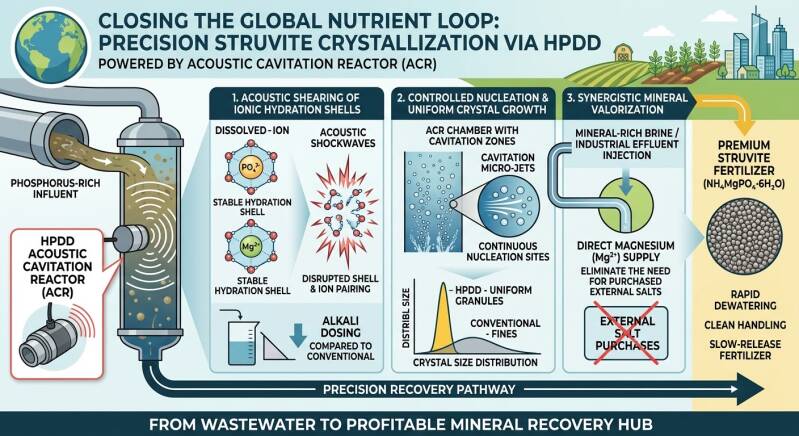
Closing the Global Nutrient Loop: Precision Struvite Crystallization via HPDD
Phosphorus is an irreplaceable, non-renewable element essential for global food security, yet vast amounts are lost daily in municipal wastewater and agricultural runoffs.
While recovering phosphorus as struvite (magnesium ammonium phosphate hexahydrate, NH4MgPO4·6H2O) is an established circular objective, conventional crystallization plants face severe operational bottlenecks:
- Sluggish nucleation kinetics requiring massive reaction vessels.
- Heavy chemical consumption (costly dosing of caustic soda and external magnesium salts).
- Inconsistent, fine crystal fines that foul downstream dewatering equipment and fail commercial fertilizer standards.
The Hydro Puls Direct-Drive (HPDD) platform, powered by the inline Acoustic Cavitation Reactor (ACR), fundamentally accelerates this crystallization pathway:
1. Acoustic Shearing of Ionic Hydration Shells:
Dissolved phosphate and magnesium ions exist locked in rigid hydration water cages that physically resist precipitation. Acoustic shockwaves mechanically disrupt these hydration barriers, enabling instantaneous ion pairing without excessive alkaline chemical conditioning.
2. Controlled Nucleation and Uniform Crystal Growth:
High-frequency cavitation micro-jets act as distributed, continuous nucleation sites. This ensures a narrow crystal size distribution (CSD) and dense, premium-grade struvite granules that dewater rapidly and handle cleanly as slow-release fertilizers.
3. Synergistic Mineral Valorization:
When integrated with mineral-rich brines or industrial effluents, the required magnesium ions can be supplied directly in-line, eliminating the need to purchase external chemical salts.
By replacing slow chemical dosing tanks with rapid, cavitation-driven mechanochemistry, HPDD turns wastewater treatment plants into profitable mineral recovery hubs.