

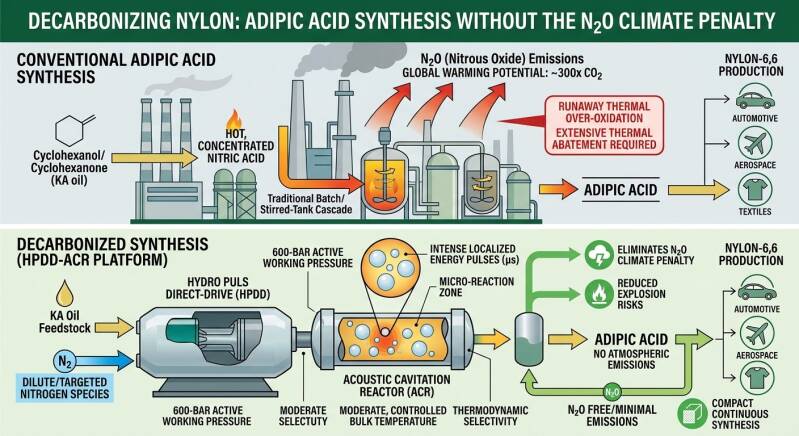
Decarbonizing Nylon: Adipic Acid Synthesis Without the N2O Climate Penalty
Adipic acid is the primary chemical precursor for Nylon-6,6, an essential polymer in automotive, aerospace, and textiles. However, its industrial synthesis carries one of the heaviest greenhouse gas footprints in modern chemical manufacturing.
Globally, the conventional oxidation of cyclohexanol/cyclohexanone (KA oil) relies on massive amounts of hot, concentrated nitric acid. This severe thermal process releases enormous volumes of nitrous oxide (N2O), a potent greenhouse gas with a global warming potential nearly 300 times that of CO2, requiring complex, capital-heavy thermal abatement systems.
The Hydro Puls Direct-Drive (HPDD) and Acoustic Cavitation Reactor (ACR) architecture provides a cleaner, high-pressure alternative:
1. In-Situ Mechanochemical Nitric Activation:
Instead of feeding bulk, highly hazardous concentrated nitric acid, the HPDD-ACR platform generates targeted reactive nitrogen species directly within the fluid matrix. The active 600-bar working pressure shifts thermodynamic selectivity toward the target dicarboxylic acid.
2. Eliminating Runaway Thermal Over-Oxidation:
Acoustic cavitation micro-reactors generate intense localized energy pulses in microseconds, while the bulk fluid remains at moderate, controlled temperatures. This precision prevents the destructive runaway reactions that convert valuable nitrogen into fugitive N2O emissions.
3. Compact Continuous Synthesis:
Traditional batch and stirred-tank oxidation cascades are replaced by a continuous, high-shear micro-reaction zone. This drastically reduces chemical holding volumes and lowers explosion risks.
Eliminating harmful emissions is not just about expensive end-of-pipe scrubbing; it requires redesigning the fundamental reaction dynamics at the core.