Marine Hybrid Propulsion: Delivering 250 kW Shaft Power Directly from Waste Heat via HPDD
The maritime industry is under immense pressure to cut fuel consumption and improve Carbon Intensity Indicator (CII) ratings, yet vast amounts of high-grade energy are still lost out the stack as exhaust waste heat.
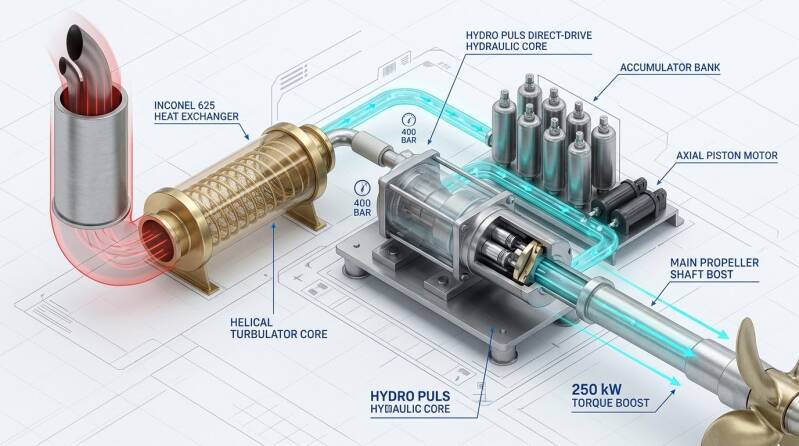
With the finalization of the technical integration specifications for our Marine Power Take-In (PTI) core, the Hydro Puls Direct-Drive (HPDD) platform couples thermal recovery directly to the vessel's propulsion shaftline. No complex electrical conversion chains, no bulky battery banks, and no grid-scale power electronics, just direct, highly regulated hydraulic shaft power injection.
Key Technical Parameters of the Marine PTI Architecture
1. 250 kW Mechanical Shaft Delivery (N = 250 kW):
Coupled to the reduction gearbox or main propeller shaft via a variable-displacement axial piston motor equipped with dynamic swashplate angle modulation. The working displacement modulates across shaft speeds (n) and varying sea states, delivering continuous power without destabilizing the HPDD core's thermal-mechanical steady state (230 °C bore calibration).
2. 400-Bar Secondary Hydraulic Circuit:
Operating within a design pressure window of 350 to 420 bar at high mechanical efficiency (eta_total = 0.92–0.95), calculated via:
Vg = (600 * N) / (p_work * n * eta_total)
3. Hydraulic Damping & Core Bellows Protection:
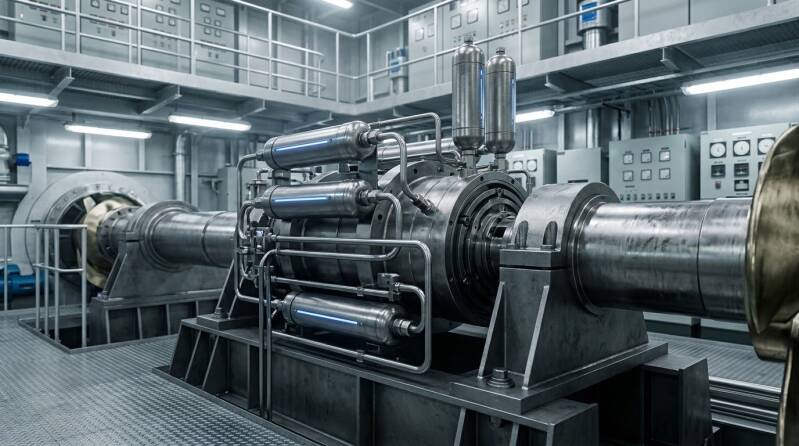
An intermediate accumulator module provides total fluid capacitance, acting as an inline surge damper. It isolates the thermal expansion core from shaftline torque spikes and valve transitions, strictly clamping cyclic differential pressure across the sealing bellows within Delta-p <= 5 bar to eliminate mechanical fatigue.
4. Inconel 625 Heat Exchanger with Helical Turbulation:
Exhaust gas heat recovery uses Inconel 625 tubing fitted with internal helical wire coil inserts (twisted-tape turbulators) rather than aggressive internal machining. This induces controlled swirl along the inner tube walls, substantially boosting heat transfer coefficients while maintaining high corrosion resistance and simple cleaning protocols.
5. Transient Maneuvering & Dynamic Load Shedding:
During engine low-load cycles or harbor maneuvering, the accumulator absorbs or supplies fluid to stabilize shaft torque. Cold-zone electrical trace heating maintains the core at operating readiness (approx. 75 bar initial pressurization), preventing parasitic fluid loops and thermal shock during sudden load pick-ups.
Direct Mechanical Decarbonization at Sea
By converting main engine exhaust thermal losses directly into 250 kW of mechanical propulsion assist, HPDD unburdens the primary engine, reduces specific fuel oil consumption (SFOC), and sets a new benchmark for clean, mechanical marine hybridization.