The Holy Grail of Petrochemicals: Direct Methane-to-Methanol Without a Syngas Plant
Cracking natural gas into liquid bulk chemicals costs billions in thermal energy and conversion losses. Why not bypass the steam reformer entirely?
Direct Methane-to-Methanol (DMTM) conversion has long been considered the ultimate frontier in industrial chemistry. The C-H bond in methane (CH4) is exceptionally strong (439 kJ/mol). The engineering barrier has always been over-oxidation: once methanol is formed, its C-H bonds are weaker than those of methane, causing conventional reactors to incinerate it immediately into CO2.
To circumvent this, industry invests billions in massive steam methane reforming (SMR) plants that heat methane above 800 °C to produce synthesis gas (CO + H2), only to re-compress it downstream into liquid fuel.
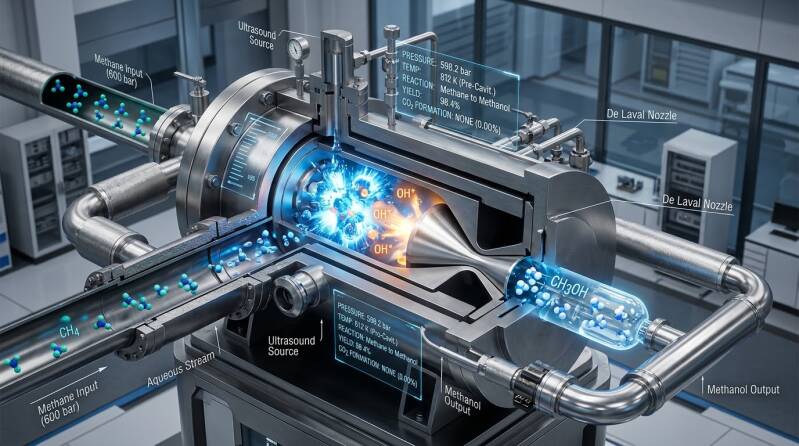
The Hydro Puls Direct-Drive (HPDD) platform, combined with the Acoustic Cavitation Reactor (ACR), breaks this thermodynamic impasse at the molecular level:
1. Maximum Reactant Density at 600 Bar:
Under ambient conditions, methane solubility in water is practically negligible. The continuous 600-bar working matrix of HPDD forces methane into ultra-dense contact with the fluid phase, eliminating separate multi-stage gas compressor trains.
2. In-Situ Hydroxyl Radical Activation:
Rather than relying on fragile, expensive homogeneous catalysts, controlled acoustic cavitation within the ACR cleaves water molecules into transient hydroxyl radicals (.OH). These micro-jet shockwaves selectively break methane's primary C-H bond at moderate bulk temperatures.
3. Millisecond Supersonic Thermal Quenching:
The over-oxidation dilemma is solved via rapid de Laval flash expansion. Immediately following synthesis, supersonic pressure drop induces instantaneous cooling, freezing the reaction kinetics. Liquid methanol condenses out cleanly before it can further oxidize into formaldehyde or CO2.
The Commercial Reality:
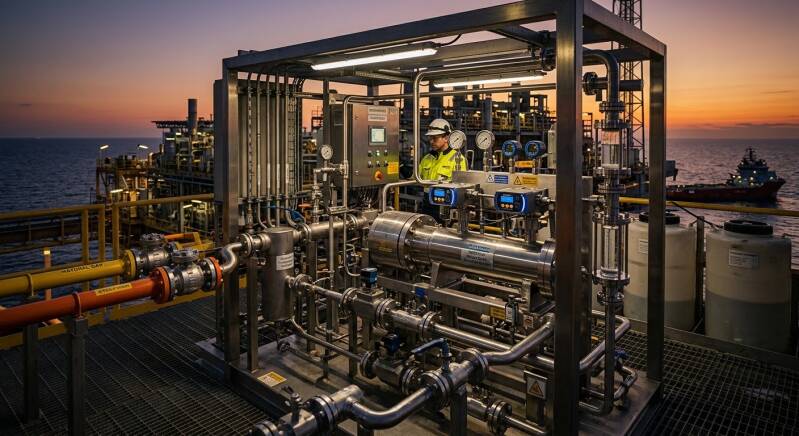
- Flare Gas Monetization: Associated gas on offshore rigs or remote wellheads is converted on-site into liquid, pipeline-ready methanol instead of being flared into the atmosphere.
- Capex Disruption: Compact, modular skid architecture replaces multi-hectare reforming infrastructure.
The leap from legacy high-temperature thermal ovens to inline, mechanochemical high-pressure synthesis is here.