

The End of Linear Chemistry: Why the Solvay (Soda Ash) Process Must Be Disrupted
Many cornerstone industrial chemical processes still operate on 19th-century linear principles: extract raw materials, burn vast amounts of fuel, extract a fraction of product, and discharge the remainder as toxic waste.
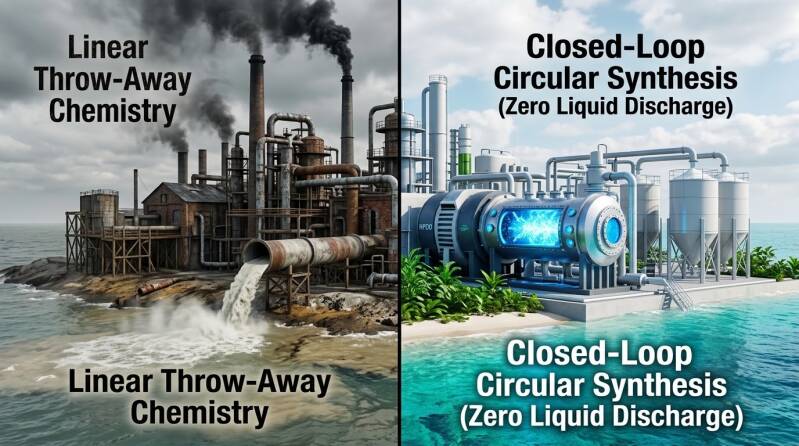
In our ongoing technical dialogue, chemical expert Srivathsan R described the current industry-standard Solvay process for soda ash (sodium carbonate) with alarming clarity: it is globally notorious, a stark example of “throw away and burn chemistry,” where extracted limestone and mineral salts ultimately return to the ocean as massive brine pollution.
His acute observation targets a significant industrial vulnerability. Modern soda ash production, while critical for glass, detergents, and EV battery precursors, generates colossal streams of calcium chloride waste and saturated brine that acidify and salinize marine habitats worldwide.
The Hydro Puls Direct-Drive (HPDD) platform, integrating the Acoustic Cavitation Reactor (ACR), proves that this era of inefficient, linear waste chemistry is officially over:
1. Zero Waste, Full Valorization (Circular Mass Balance):
Instead of discharging vast volumes of reject brine, HPDD hermetically locks the loop (delta-Mass = 0.000 kg). Every ionic component, from magnesium and calcium to sodium, is mechanochemically sheared, separated, and synthesized into high-value, technical-grade industrial salts or specialized fertilizers. Waste is engineered out.
2. Eliminating External Thermal Steam Dependency:
The colossal activation energy and chemical equilibrium shifts required for synthesis are delivered directly via the active 600-bar fluidic matrix and inline acoustic cavitation. We bypass the energy-intensive steam boilers and massive thermal penalties that have defined the Solvay process for over 160 years.
3. From Brine Liability to Pure Asset Hub:
Where conventional Solvay plants battle regulatory penalties, escalating disposal costs, and marine pollution, HPDD turns an industrial mineral stream directly into multiple diversified, high-purity revenue streams.
As Srivathsan accurately concluded, this thermodynamic breakthrough belongs in the commercial arena. Working with strategic partners like Mukul Pant and leveraging the fundamental cavitation science pioneered by Professor Mohamed, we are making the definitive shift from linear incineration chemistry to a pure, thermodynamically closed circular future.