

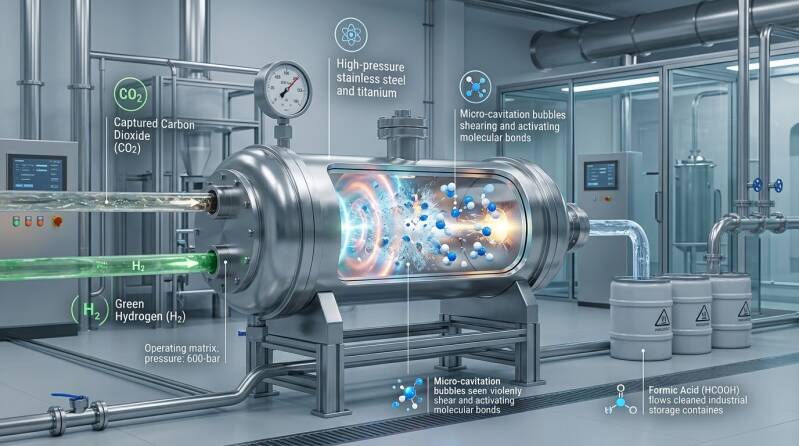
From CO2 Emission to High-Value Chemical Highway: Formic Acid via HPDD
What if industrial carbon capture did not end with underground storage, but instead directly synthesized a high-density liquid energy carrier and chemical building block?
During a rigorous technical exchange regarding our high-pressure mass balances, chemical engineering expert Srivathsan R raised a compelling pathway: the direct hydrogenation of carbon dioxide into Formic Acid (HCOOH).
His insight highlights a major frontier in modern C1 chemistry. Industrially, the direct conversion of CO2 and H2 into formic acid (CO2 + H2 <=> HCOOH) has always faced severe thermodynamic constraints under conventional pressures, demanding energy-intensive multistage compressors, expensive homogeneous catalysts, and costly separation stages.
The Hydro Puls Direct-Drive (HPDD) architecture and its integrated Acoustic Cavitation Reactor (ACR) resolve this exact bottleneck:
1. Thermodynamic Equilibrium at 600 Bar (Le Chatelier's Principle):
Because the hydrogenation of gaseous CO2 and H2 into condensed-phase formic acid involves a negative reaction volume change (delta-V < 0), high pressure dramatically favors product formation. The continuous 600-bar working matrix of HPDD shifts equilibrium toward high single-pass yields without separate external compressor trains.
2. Breaking Kinetic Barriers via Acoustic Cavitation:
In the Acoustic Cavitation Reactor, transient bubble collapses produce localized micro-zones of extreme shear, intense temperatures, and micro-jetting. This mechanochemically accelerates mass transfer between gas and dense fluid phases, drastically lowering effective activation barriers.
3. Formic Acid as a Liquid Organic Hydrogen Carrier (LOHC):
Formic acid packs approximately 53 g H2/L (4.4 wt% hydrogen) as an ambient-stable liquid. It serves both as a safe, pipeline-ready hydrogen vector and a vital precursor for textiles, agriculture, and downstream C1 syntheses (such as methanol and formaldehyde).
Special thanks to Srivathsan R for his sharp technical scrutiny. Dialogues like this demonstrate that HPDD is far more than a direct mechanical drive or advanced desalination system, it functions as a versatile, high-pressure thermochemical platform powering the future of the circular economy.