

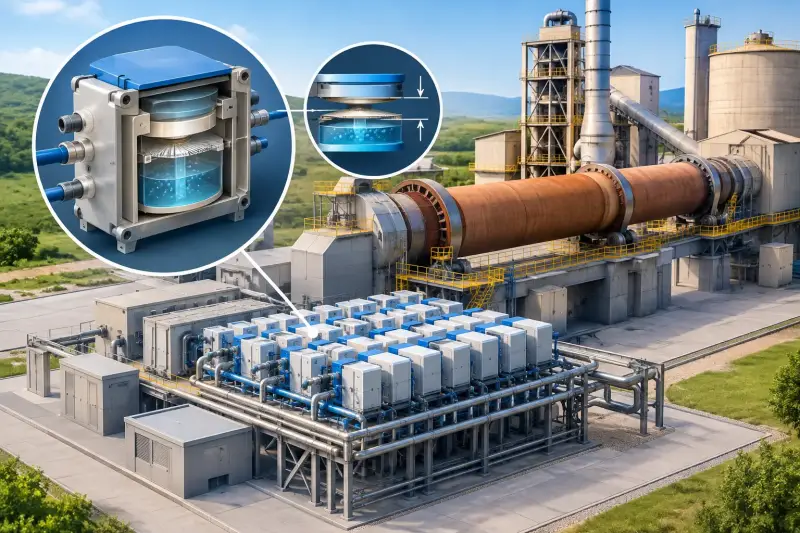
Sizing CHP for Cement Kilns at Full Load.
A cement kiln does not need a CHP plant sized to its nameplate electrical demand; it needs an energy system sized to its most critical constraint: stable clinker output.
Oversizing against an annual energy spreadsheet erodes economics if it forces export dependence, bypasses low-grade heat, or loses efficiency whenever the kiln moves away from its design point.
Sizing CHP for an integrated works is an operational decision of heat quality, dispatchability, and process integration.
Start With the Kiln Line, Not the Generator
The kiln, preheater tower, calciner, mills, and clinker cooler form an interconnected thermal system with variable demand.
Feed moisture shifts, alternative-fuel substitution alters combustion, and milling cycles trigger heavy swings. Engineering teams must model time-series data (15-minute or hourly resolution over a full year) rather than averages.
The key metric is not peak generation capacity, but the continuous energy output the plant can reliably absorb while the kiln operates in its core production window.
Size to the Minimum Valuable Load
The most bankable CHP capacity matches the minimum sustained baseload during normal operation.
If an 18 MW baseline fluctuates between 14 MW and 24 MW, sizing near 14 MW delivers a higher utilization factor and avoids stranded generation.
Thermal sizing demands equal rigor: heat must be matched via a thermal cascade. High-grade exhaust should be reserved for drying raw materials and fuels, while medium- and low-grade heat serves building utilities, water treatment, or carbon capture regeneration.
Electrical Quality and Direct-Drive Decoupling
Vertical roller mills, crushers, and process fans generate severe startup currents, harmonics, and sudden load steps.
A system sized purely on steady-state energy balances risks kiln trips during electrical transients or islanded operation.
This is where the Hydro Puls Direct Drive (HPDD) architecture changes industrial integration.
Serving as an Autonomous Energy Heart, HPDD decouples power conversion from dynamic plant loads via direct fluidic transfer and integrated storage. The core process maintains continuous, high-efficiency operation while the hydraulic layer absorbs mill and fan transients directly.
Fuel Transition and Lifecycle Viability
A CHP unit installed beside a kiln operates for decades. Sizing must accommodate modular fuel transitions, from natural gas to hydrogen, ammonia, or plant-derived fuels, without stranding balance-of-plant assets. Modularity also allows staged expansion alongside future carbon capture, which introduces heavy thermal regeneration and gas compression loads.
Evaluate CHP through net plant value under actual operating cases: normal kiln duty, raw-mill-off operation, and maintenance modes.
The winning design is not the one boasting the largest datasheet rating, but the system that preserves clinker continuity and converts every megawatt into useful operational work.