

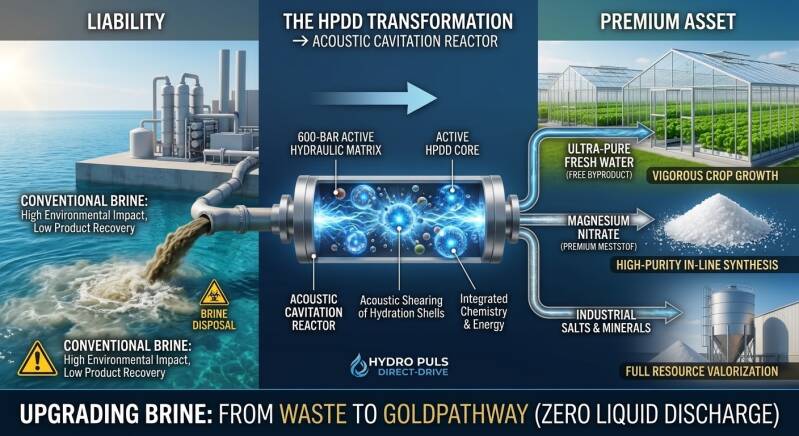
From Toxic Liability to Premium Asset: Upgrading Desalination Brine with HPDD
In the global desalination sector, reject brine is still treated as an environmental burden and an expensive disposal liability. We see it as an unexploited mineral mine.
Conventional seawater reverse osmosis (SWRO) recovers on average only 40% to 45% fresh water. The remaining 55% is discharged back into coastal waters as a hyper-saline, chemically dosed concentrate. The results are well known: severe marine habitat degradation, escalating permitting roadblocks, and steep regulatory penalties on brine disposal.
The Hydro Puls Direct-Drive (HPDD) platform, coupled with our inline Acoustic Cavitation Reactor (ACR), fundamentally transforms this paradigm, converting a high-impact waste stream into a diversified, high-margin revenue model.
The Three Pillars of Value Creation
1. Mechanochemical Mineral Shearing (Zero Evaporation Boiling)
Instead of boiling brine down with massive thermal energy inputs, the Acoustic Cavitation Reactor applies targeted hydraulic shockwaves under a continuous 600-bar working matrix. These extreme localized micro-jets mechanically strip the dense hydration shells binding divalent magnesium ions, enabling rapid phase transformation at ambient temperatures.
2. In-Line Magnesium Nitrate Synthesis
By integrating stoichiometric nitrogen chemistry directly into the fluid core, dissolved magnesium selectively precipitates as technical-grade magnesium nitrate. This is not a low-value mixed waste salt; it is a high-solubility, premium fertilizer demanded worldwide for controlled-environment agriculture and horticulture.
3. True Zero Liquid Discharge (ZLD)
The remaining effluent crystallizes quantitatively into separated industrial-grade salts and mineral cakes. Zero cubic meters of toxic reject effluent return to the sea. The mass balance closes hermetically at delta-Mass = 0.000 kg.
Disrupting Economics: Negative Levelized Cost of Water
When revenue generated from crystal-grade magnesium nitrate and purified industrial salts outpaces total baseline operating expenditure, the economic dynamic shifts: ultra-pure fresh water ceases to be an operational expense, it becomes a profitable byproduct.
Where traditional desalination plants face mounting power costs and tightening discharge regulations, HPDD transforms brine management from the project's greatest vulnerability into its most lucrative revenue engine.
Stop dumping valuable minerals into the ocean. Upgrade brine at the molecular level.