

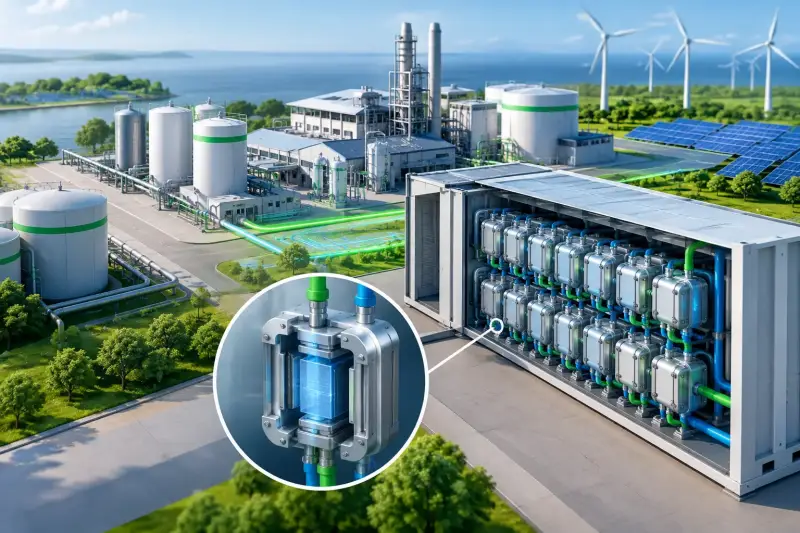
Industrial Decarbonization: Moving Toward an Integrated Energy Core.
A cement kiln cannot wait for a windless afternoon to pass; a data center cannot curtail compute when grid congestion appears. Industrial decarbonization is no longer defined by carbon accounting alone, but by operational continuity.
The viability of an energy architecture depends on reliably delivering firm power, usable heat, process cooling, mechanical work, and water, while eliminating parasitic conversion losses.
1. From Isolated Assets to Unified Thermodynamics
For decades, industrial facilities operated as fragmented islands: an engine or turbine for power, a boiler for thermal energy, and separate compressors or pumps for movement. Every conversion interface introduces compounding losses, maintenance burdens, and partial-load penalties.
Authentic decarbonization does not merely substitute a fossil-fueled engine with an electrified counterpart. It matches the energy source directly to the industrial process load. When an application ultimately requires hydraulic pressure or fluid displacement, converting combustion heat into electricity only to convert it back into mechanical work adds redundant losses. Direct coupling eliminates these intermediate stages entirely.
2. Useful Energy: The Pragmatic Metric
Evaluating efficiency solely through an electrical lens is too narrow for sectors like water refining, cement, chemical processing, and data campuses. The primary metric is shifting to total useful energy delivered per unit of fuel, capital, and physical footprint. High-value operations require systems that capture multi-output streams, turning potential thermal and hydraulic waste into functional inputs.
3. Phased Fuel Flexibility and Modular Deployment
While green hydrogen and clean ammonia are vital long-term energy carriers, local supply logistics and infrastructure remain uneven. Industrial sites cannot risk stranded capital on single-fuel assets. They require transitional infrastructure capable of operating efficiently on current fuels today, with an engineered pathway to adopt hydrogen or ammonia without replacing core assets.
Simultaneously, modular scalability is replacing massive centralized builds. Deploying standardized blocks reduces permitting barriers, avoids grid interconnection delays, and allows industrial operators to scale capacity alongside actual demand.
4. The Rise of the Industrial Energy Core
Industrial procurement is transitioning from purchasing disparate machines to implementing a coherent energy core. Hydro Puls Systems addresses this paradigm via the Hydro Puls Direct Drive (HPDD) architecture. By replacing conventional crankshaft mechanics with pulse-based combustion and direct hydraulic energy transfer, the platform bypasses conventional friction and auxiliary drag.
The leaders of industrial decarbonization will not be those setting distant net-zero targets. They will be the operators deploying resilient architectures capable of navigating volatile fuels, constrained grids, and rigid production schedules without sacrificing industrial output.