

Seawater contains magnesium chloride, not nitrate. Where does your nitrogen come from without external chemical feedstocks?"
This is by far the most frequent question we receive regarding the Hydro Puls Direct-Drive (HPDD) mineral refinery architecture. And for any chemical engineer looking strictly at mass balance, the skepticism is completely justified: seawater contains dissolved Mg²⁺ and Cl⁻, but virtually zero nitrate (NO₃⁻).
Yet, our process requires zero external acid trucks, zero chemical deliveries, and zero mining intermediates.
Here is how the closed thermodynamic and stoichiometric loop works:
1. The Fuel Is the Nitrogen Precursor
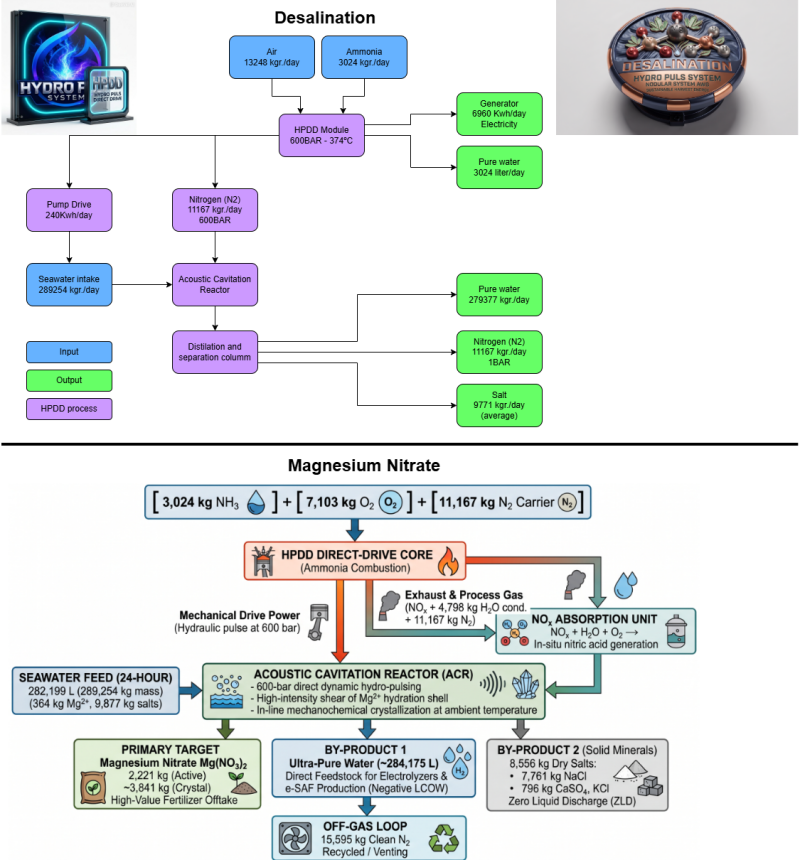
The HPDD prime mover is fueled by clean ammonia (NH₃). Controlled combustion within our direct-drive core yields two vital outputs:
• 600-bar direct mechanical hydraulic pulse energy.
• An off-gas stream of NOx and high-purity reaction water (H₂O).
2. In-Situ Acid Generation
Instead of treating NOx as a catalytic disposal problem, it is captured inline in an absorption loop with process water. This synthesizes the exact stoichiometric amount of nitric acid (HNO₃) required on-site, fully utilizing the input nitrogen.
3. Mechanochemical Shearing (ACR at 600 bar)
Traditional brine processing fails economically because boiling off water to de-hydrate the rigid shell around Mg²⁺ ions consumes massive thermal energy.
Our Acoustic Cavitation Reactor (ACR) bypasses thermal evaporation entirely. By deploying tuned acoustic shockwaves at 600 bar, we mechanically shear the hydration shell of Mg²⁺ in milliseconds. The active magnesium immediately bonds with the in-situ nitrate stream, triggering selective crystallization of commercial Magnesium Nitrate (Mg(NO₃)₂) at ambient temperature.
A 24-Hour Production Snapshot:
• Feedstock: 282,199 L Seawater + 3,024 kg NH₃ fuel + process air.
• Yield:
- ~3,840 kg crystallized Magnesium Nitrate fertilizer ($400–$1,000+/ton).
- ~284,000 L ultra-pure demineralized water (ideal for H₂/e-SAF electrolysis, achieving negative LCOW).
- Dry technical salts (NaCl, KCl, CaSO₄) with Zero Liquid Discharge (ZLD), no toxic brine dumped back into marine ecosystems.
We don't need external chemical supply chains. By using ammonia as both the mechanical driver and the chemical donor, HPDD transforms coastal water treatment from a waste-disposal liability into a profitable mineral refinery.
Curious to review the complete block flow diagram (BFD) and reaction kinetics? Let’s discuss in the comments below or connect via DM.
#Desalination #CleanTech #Hydrogen #HPDD #PowerToX #Fertilizer #CircularEconomy #ZeroLiquidDischarge #ChemicalEngineering