

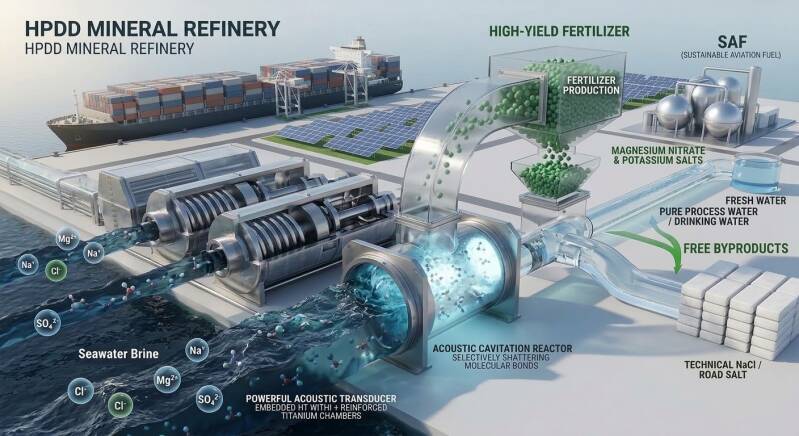
"We are not building a desalination plant with a waste problem; we are building an in-line mineral refinery that transforms seawater into high-yield fertilizers—with pure water and industrial salt as free by-products."
For decades, the global desalination model has been fundamentally flawed: spend massive electrical energy to extract 45% fresh water, while dumping millions of cubic meters of toxic, hypersaline reject brine back into our marine ecosystems.
The Hydro Puls Direct-Drive (HPDD) architecture turns this economic equation entirely on its head:
- Primary High-Margin Production: Instead of treating bivalent ions (Mg^{2+}, K^+, SO_4^{2-}) as scalants to fight, our Acoustic Cavitation Reactor (ACR) selectively targets specific hydration shell activation energies. Direct acoustic energy shears ionic bonds in-line, driving instant crystallization into high-purity magnesium nitrate and specialty potassium salts ($400–$1,000+/ton).
- Free Technical By-Products: Because high-value specialty fertilizers carry the plant's capex and opex, the massive output of ultra-pure process water operates with a negative Levelized Cost of Water (LCOW)—ideally positioned to feed adjacent green hydrogen and Sustainable Aviation Fuel (SAF) electrolysis without extra treatment.
- Zero Liquid Discharge (ZLD): The remaining stream leaves as dry, commercial-grade technical NaCl (de-icing / chlor-alkali), leaving zero toxic brine plumes in the ocean.
True circular engineering does not manage waste—it designs waste out of physics entirely.
#Desalination #CleanTech #Fertilizer #CircularEconomy #ZeroLiquidDischarge #SustainableAviation #GreenHydrogen #HPDD #Wate
rEnergyNexus