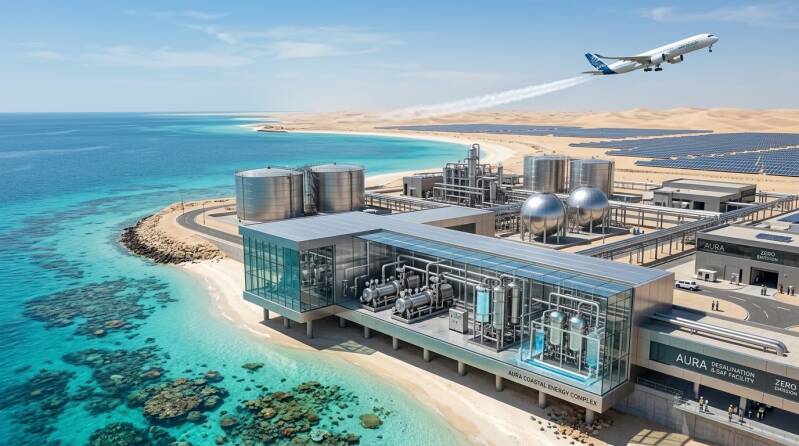
The Missing Link for Scalable Sustainable Aviation Fuel (SAF): Ultra-Pure Process Water Without the Marine Ecological Footprint.
Decarbonizing global aviation is non-negotiable. However, scaling synthetic e-SAF (power-to-liquid) requires massive volumes of green hydrogen and high-purity process water, demanding roughly 3 to 5 liters of ultra-pure water for every single liter of synthetic fuel produced.
The challenge? The world’s prime locations for low-cost renewable power (solar and wind) are situated in arid coastal regions, the Middle East, North Africa, and coastal deserts where freshwater is critically scarce.
Conventional seawater desalination bridges this water gap, but at a catastrophic ecological cost: intensive energy consumption and millions of cubic meters of toxic, hypersaline brine discharged back into marine ecosystems, suffocating coastal seabeds.
How the Hydro Puls Direct-Drive (HPDD) Platform Breaks the Water-Energy-SAF Bottleneck:
Zero Liquid Discharge (ZLD) as Standard: By coupling continuous direct mechanical pressure at 600 bar with mechanochemical separation, high-TDS reject streams are transformed into valuable industrial-grade solid minerals (such as magnesium nitrate) instead of toxic marine discharges.
Slashing Parasitic Energy Demand: Operating with direct hydraulic displacement eliminates conventional crankshaft mechanical losses, establishing a mechanical baseline efficiency exceeding 61% and drastically lowering the renewable gigawatt footprint required for feedstock water production.
Enabling a Negative LCOW: In-situ mineral extraction offsets water generation costs, creating a negative Levelized Cost of Water (LCOW) that directly lowers production costs for green hydrogen and subsequent e-SAF synthesis.
We cannot solve atmospheric emissions by destroying our oceans with hypersaline run-off. True industrial decarbonization demands treating water, minerals, and clean fuels as a single closed thermodynamic system.
#SustainableAviation #SAF #Desalination #CleanWater #ZeroLiquidDischarge #GreenHydrogen #HPDD #CircularEconomy #EnergyTransition