

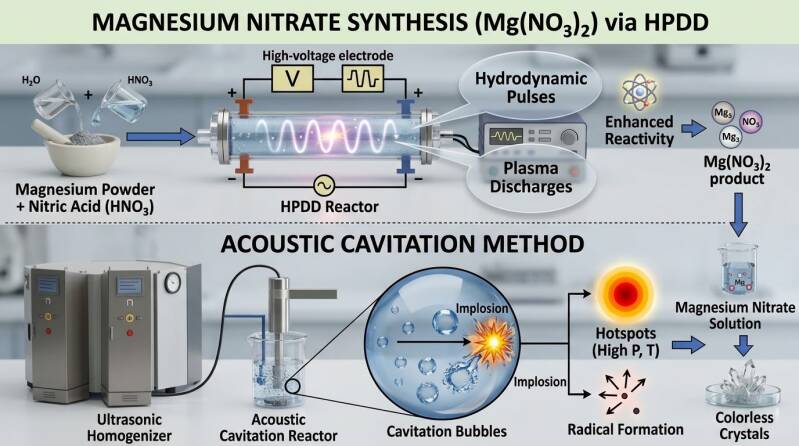
Magnesium Nitrate Synthesis via HPDD & Acoustic Cavitation
How It Works: Mechanochemical Synthesis Without External Furnaces
Conventional synthesis of nitrogen-magnesium compounds relies on expensive chemical intermediates, refined metallic feedstock, or energy-intensive calcining furnaces. The Hydro Puls Direct-Drive (HPDD) architecture pairs direct thermodynamics with an Acoustic Cavitation Reactor to synthesize magnesium nitrate [Mg(NO_3)_2] directly from process streams and brine:
- Nitrogen and Enthalpy Feed: The hermetic HPDD cycle continuously supplies an activated, high-pressure nitrogen stream (600 bar, 374C to 800C).
- Acoustic Cavitation & Radical Formation: Inside the reactor chamber, supersonic fluid dynamics generate intense acoustic cavitation. Local bubble implosions produce transient micro-temperatures up to 5,000 K and shockwaves reaching thousands of bar. These conditions break the strong triple nitrogen bond (N \equiv N) and strip the hydration shells surrounding dissolved magnesium ions (Mg^{2+}) sourced from seawater or industrial brine.
- Targeted In-Situ Recombination: In the presence of integrated oxidative radicals, activated nitrogen bonds directly with free magnesium cations to form high-purity magnesium nitrate [Mg(NO_3)_2], which is rapidly crystallized via flash evaporation into solid flakes.
Key Advantages
- Zero Metallic Feedstock: Synthesizes directly from liquid brine streams and desalination reject without requiring costly pre-processed magnesium metal.
- Zero External Heating Duty: Operates entirely on the internal thermal enthalpy and mechanical fluid power of the closed HPDD cycle.
- Hermetic & Zero-Emission: Eliminates exhaust stacks, atmospheric NO_x emissions, and hazardous secondary chemical waste.
- Multi-Product Stream: Delivers baseload electricity, potable water, and industrial-grade minerals simultaneously within a single integrated footprint.
Applications
- Precision Agriculture & Hydroponics: Provides a fully water-soluble fertilizer delivering readily bioavailable nitrogen and magnesium with zero chloride residue.
- Advanced Thermal Storage (Phase Change Materials - PCM): Serves as an effective heat-storage medium in molten-salt and latent-heat thermal management systems.
- Industrial Chemistry & Catalyst Supports: Functions as a high-grade precursor for producing ultra-pure magnesium oxide (MgO) and specialized catalysts.
- Technical Ceramics & Surface Treatments: Acts as an essential intermediate in refractory ceramics, protective coatings, and corrosion-resistant metal finishing.
Financial & Commercial Value
- Transforming Brine Liabilities into Assets: Eliminates discharge disposal fees and environmental compliance penalties by upcycling brine into high-demand industrial commodities (Zero Liquid Discharge).
- Drastically Reduced OPEX: Eliminating purchased metallic magnesium and external electrical heating slashes synthesis operating costs by over 60% compared to traditional chemical routes.
- Accelerated Capital Payback: The co-production of power, pure water, and high-value chemical products creates multi-vector revenue streams, significantly compressing the payback period of the HPDD installation.