

The pulp and paper industry consumes nearly 6% of the world’s industrial energy, largely because breaking down biomass still relies on a century-old recipe of extreme heat and toxic chemicals.
To extract pure cellulose fibers from wood or agricultural residues, the industry typically uses the Kraft process: cooking biomass at 170 °C in a bath of sodium sulfide and caustic chemicals. The result? Massive steam boilers, harsh "black liquor" waste streams, and severe thermodynamic penalties.
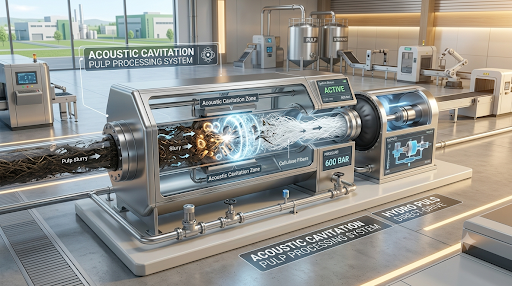
With Hydro Puls Direct-Drive (HPDD) and the Acoustic Cavitation Reactor, we are replacing brute-force thermochemical cooking with targeted mechanochemistry:
- Nanoscale Lignin Cleavage: Intense acoustic cavitation implosions generate localized shockwaves that shatter the rigid lignin matrix physically, leaving the delicate cellulose fibers intact without aggressive sulfur compounds.
- 40% Thermal Energy Reduction: Mechanochemical activation allows fiber separation to occur at significantly lower bulk temperatures (60–80 °C), slashing industrial boiler duty.
- Closed-Loop Drying Integration: HPDD directly converts fluidic energy at 600 bar while harvesting internal cycle heat, routing high-grade thermal energy straight into the paper machine’s drying section.
- Unlocking Non-Wood Agricultural Waste: Straw, hemp, and bagasse—historically difficult and costly to pulp—can now be processed continuously without fouling conventional equipment.
- Zero Harmful Effluents: Moving away from sulfur-heavy pulping eliminates toxic wastewater, enabling true Zero Liquid Discharge (ZLD) closed loops.
True industrial decarbonization is not just about switching the fuel of your steam boiler; it is about fundamentally rethinking how you separate molecules.
#PulpAndPaper #Biorefinery #HPDD #AcousticCavitation #CleanTech #ProcessEngineering #Bioeconomy #Decarbonization #CircularEconomy #IndustrialInnovation