Mild, Closed-Loop Palm Oil Refining (CPO & CPKO)
Upgrade crude palm oil into export-grade RBD palm oil without heavy chemical degumming, high-temperature thermal degradation, cooling towers, or stack emissions.
Conventional chemical and physical palm oil refineries rely on high-pressure steam boilers, heavy phosphoric acid and caustic dosing, large volumes of spent bleaching earth, and high-temperature deodorization (250–270 °C). Beyond high energy and water demand, extreme deodorization temperatures cause neutral oil losses, strip natural tocotrienols (Vitamin E), and accelerate the formation of 3-MCPD and glycidyl esters (GE).
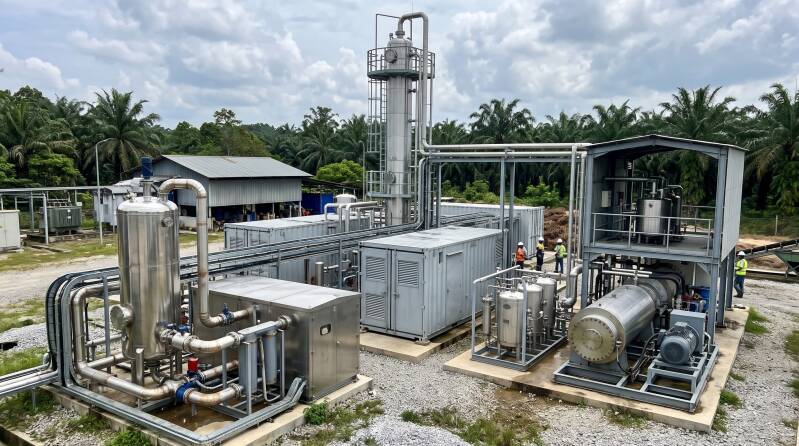
Hydro Puls Systems replaces energy-heavy steam and chemical refining trains with a compact, modular, closed-loop architecture designed for remote plantation and mill sites.
How the HPDD + ACR + VCD Platform Refines Crude Palm Oil
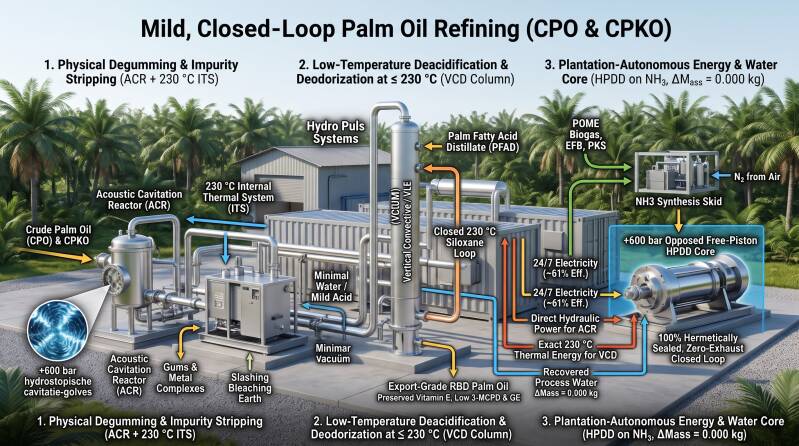
1. Physical Degumming & Impurity Stripping (ACR + 230 °C ITS):
Crude Palm Oil (CPO) and Crude Palm Kernel Oil (CPKO) contain phosphatides (gums), trace metals (iron and copper), and pigments. Routing the feedstock through our Acoustic Cavitation Reactor (ACR)—driven by +600 bar hydrostatic pulses and paired with our unpressurized 230 °C Internal Thermal System (ITS)—generates intense interfacial micro-cavitation. Hydratable and non-hydratable gums and metal complexes are separated rapidly with minimal water or mild organic acid dosing, eliminating heavy caustic soapstock and slashing bleaching earth consumption.
2. Low-Temperature Deacidification & Deodorization at ≤ 230 °C (VCD Column):
Operating under controlled vacuum, our Vertical Convective / VLE Column (VCD) utilizes cascaded thermal gradients from the closed 230 °C siloxane loop to strip Free Fatty Acids (PFAD) and volatile odor compounds cleanly at or below 230 °C. By avoiding extreme 260 °C+ thermal spikes, the VCD column preserves natural antioxidants (tocotrienols and carotenoids), minimizes neutral oil losses, and significantly suppresses 3-MCPD and glycidyl ester formation.
3. Plantation-Autonomous Energy & Water Core (HPDD on NH3, ΔMass = 0.000 kg):
Remote palm oil mills generate abundant organic residues—including Palm Oil Mill Effluent (POME) biogas, Empty Fruit Bunches (EFB), and Palm Kernel Shells (PKS). These residues provide hydrogen-rich gas that, combined with nitrogen from ambient air, feeds a compact on-site ammonia (NH3) synthesis skid. Our +600 bar opposed free-piston HPDD core (with a frictionless 25-micron gas-curtain seal) runs exclusively on NH3 inside a 100% hermetically sealed, zero-exhaust closed loop—delivering 24/7 electricity (~61% net electrical efficiency), direct hydraulic power for the ACR, exact 230 °C thermal energy for VCD fractionation, and clean recovered process water with zero stack emissions and zero cooling towers.
Strategic Benefits for Palm Oil Mills & Refineries
- Export-Grade Quality & Higher Oil Yield: Lower 3-MCPD/GE levels, preserved Vitamin E fractions, and reduced neutral oil loss.
- Valuable Co-Product Recovery: High-purity Palm Fatty Acid Distillate (PFAD) alongside clean, reusable process water.
- 100% Off-Grid Plantation Autonomy: Turn POME, EFB, and PKS residues into continuous power, 230 °C refining heat, and water without diesel backup or steam boilers.