

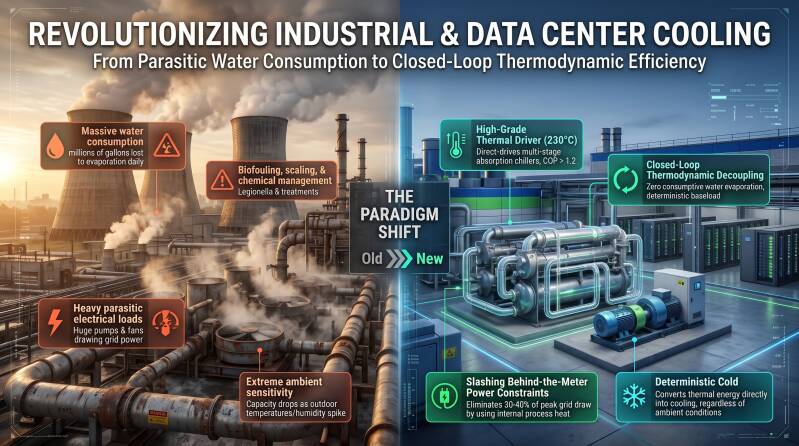
Why traditional water cooling in heavy industry and data centers is hitting a wall, and how HPDD fundamentally changes the paradigm.
Conventional evaporative water cooling and wet cooling towers come with severe operational liabilities:
• Massive water consumption (millions of gallons of treated water lost to evaporation daily).
• Chronic scaling, biofouling, and strict chemical biocide / legionella management.
• Heavy parasitic electrical loads from massive circulation pumps and fans, degrading overall PUE.
• Extreme ambient sensitivity: cooling capacity drops precisely when outside temperatures and humidity spike.
The Hydro Puls Direct-Drive (HPDD) architecture:
Instead of treating cooling as a parasitic water and power drain, HPDD integrates thermal enthalpy and direct mechanical displacement at the core:
1. High-Grade Thermal Driver (230°C):
The synchronous 230°C reaction heat directly drives high-efficiency multi-stage absorption chillers (COP > 1.2). High-grade enthalpy is converted immediately into deep industrial chilling, bypassing megawatt-scale electric compressors.
2. Closed-Loop Thermodynamic Decoupling:
Zero consumptive water evaporation. The system delivers constant, deterministic baseload cooling regardless of ambient humidity, local water scarcity, or municipal supply restrictions.
3. Slashing Behind-the-Meter Power Constraints:
By meeting the heavy chilling demand directly through internal process heat behind the meter, you eliminate 30–40% of the facility's peak grid draw, freeing up power capacity right where local substations are congested.
Instead of evaporating millions of liters of water, thermal energy is converted directly into deterministic cold.
#ProcessEngineering #IndustrialCooling #ThermalManagement #DataCenters #HPDD #EnergyEfficiency #Sustainability #CleanTech