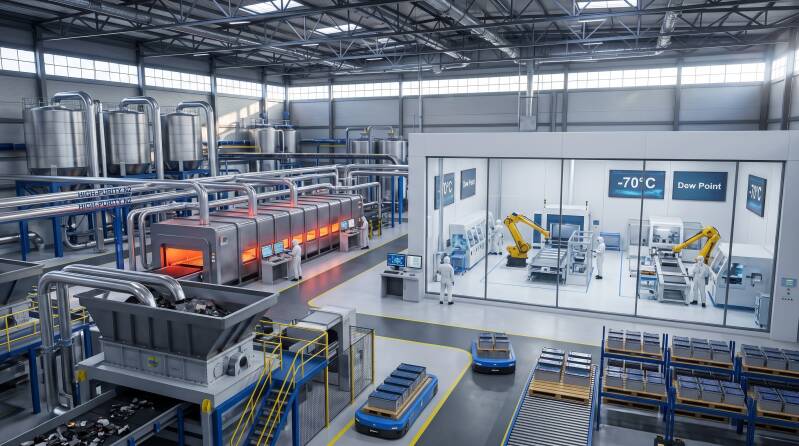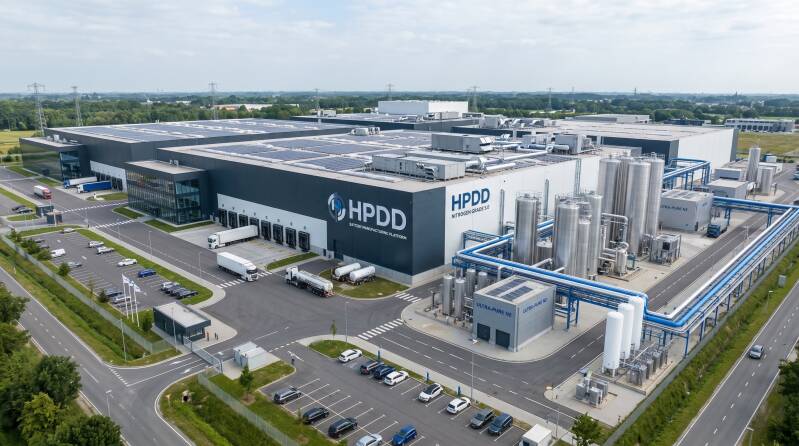
In the battery manufacturing sector, upgrading the HPDD nitrogen stream to Grade 5.0 (99.999% purity) (< 10 ppm total impurities, < 1 ppm moisture, < 2 ppm oxygen) transforms the platform from an energy core into a direct industrial utility that eliminates major operational bottlenecks.
1. Eliminating Oxidation in Roller Hearth Kilns (Cathode Calcination)
During the thermal synthesis of advanced, high-nickel cathode active materials (such as NMC 811 or 9½½) in roller hearth kilns, even minimal oxygen contamination (> 10 ppm) induces premature oxidation of Ni^{2+} into inactive phases, degrading battery cell capacity.
- Existing bottleneck: Plants consume immense volumes of nitrogen to purge kilns continuously, facing supply volatility and continuous boil-off losses from external liquid nitrogen (LN_2) storage.
- HPDD optimization: Ultra-pure 99.999% nitrogen delivered on-site is intrinsically free of hydrocarbons and compressor lubricants, completely preventing carbon deposits, coking, or oxidation defects on active cathode particles.
2. Deep Dew-Point Suppression in Dry Rooms & Electrolyte Filling
During cell filling with liquid electrolyte (LiPF_6), ambient moisture traces trigger the formation of hydrofluoric acid (HF), which degrades internal components and causes rapid cell failure.
- Existing bottleneck: Massive mechanical dehumidification wheels run 24/7 to hold dry rooms between -40 °C and -60 °C dew points, consuming up to 30% of total cell assembly electricity.
- HPDD optimization: Passing the high-pressure nitrogen through the downstream molecular sieve bed yields an ultra-dry stream with a dew point below -70 °C (< 1 ppm H_2O). Directing this gas into glove boxes and electrolyte filling chambers minimizes cell scrap rates and sharply reduces baseline dehumidifier power draw.
3. Safe, Continuous Inertization in Black Mass Shredding (Recycling)
Mechanical recycling of spent lithium-ion battery modules generates volatile organic solvent vapors from residual electrolyte alongside fine graphite dust.
- Existing bottleneck: High risk of thermal runaway and dust explosions during shredding requires heavy inertization with constant gas monitoring and compressor uptime.
- HPDD optimization: Supplying 99.999% nitrogen under positive pressure establishes a safe, oxygen-depleted enclosure across the shredder and milling circuits without requiring large, dedicated external gas compressors.
4. Zero-Contamination Pneumatic Conveying of Fine Powders
Moving finished precursor poeders, coated synthetic graphite, and active cathode materials from silos to mixing vessels requires pneumatic conveying.
- Existing bottleneck: Traditional oil-free air compressors risk filter blow-through, moisture uptake, and micro-particle contamination that can spoil high-value batches.
- HPDD optimization: Dry, oil-free 99.999% nitrogen acts directly as the conveying gas, ensuring the active powders remain protected against oxidation and ambient humidity throughout internal transit.