

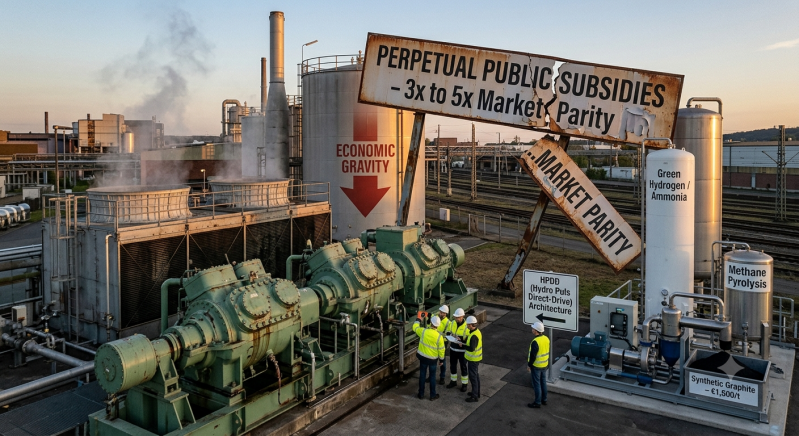
Why Subsidies Hide Bad Thermodynamics:
The Pull of Economic Gravity
If a chemical or clean energy project requires perpetual public subsidies to show a positive IRR, it rarely has a market adoption problem.
It has a thermodynamic problem.
Subsidies, tax credits, and regulatory mandates are designed to accelerate deployment curves, not to subsidize mechanical friction and exergy destruction forever.
When policy acts as a crutch for poor process physics, it creates fragile business cases that collapse the moment political winds change or funding caps hit.
Economic gravity always wins in the end.
The Flaw of Subsidizing Inefficiency
Consider the conventional Power-to-Liquid (PtL) and green hydrogen playbooks:
* The Multi-Stage Compression Trap: Generating gas at near-ambient pressure and using multi-megawatt rotary compressor trains to climb up to synthesis pressures (+200 to +600 bar).
You burn immense parasitic energy just fighting mechanical friction, heat rejection, and seal leakages.
* Single-Product Vulnerability: Spending billions on CapEx to make a single molecule (like e-kerosene or green ammonia) while discarding or failing to valorize high-energy solid co-products.
* The "Green Premium" Illusion: Expecting offtakers to permanently pay 3x to 5x market parity because a certificate of origin says it's green.
Subsidies mask these inefficiencies on a spreadsheet, but they cannot fix the underlying Carnot and mechanical realities on the plant floor.
Engineering for Pure Physics: Direct Pressure & Value Stacking.
A truly bankable energy architecture doesn't ask the state to guarantee its margins. It relies on thermodynamic optimization and combi-production to make the numbers work on day one:
1. Native Pressure Over Parasitic Work
Compressing gas in multi-stage rotating machines is thermodynamically wasteful.
By utilizing direct hydraulic pulse displacement, such as the Hydro Puls Direct-Drive (HPDD) architecture—process streams reach +600 bar natively. Bypassing parasitic compressor trains saves massive operating power and eliminates mechanical failure points.
2. Arbitrage Through High-Value Solid Carbon
Clean hydrogen and e-fuels shouldn't carry the full CapEx burden alone.
By dissociating methane into hydrogen and high-purity, battery-grade synthetic graphite (~€1,500/t) simultaneously, the high-margin solid carbon absorbs the capital expenditure. The resulting clean molecules aren't burdened by high levelized costs, they become net-profitable coproducts.
3. Frictionless, Hermetic Execution
Preventing catalyst poisoning 0.00\ppm oil carryover via hermetic isolation) extends bed life by years, eliminating hidden maintenance overheads that typically erode subsidized models.
The Reality Check for Plant Developers
Policy mandates like ReFuelEU Aviation or carbon tariffs can open the door, but they cannot keep the lights on if your core thermodynamic conversion is flawed.
If your plant only works when taxpayers fund the margin, you have an engineering liability.
When your process is engineered around direct high-pressure fluidics, zero mechanical compromise, and complete co-product monetization, profitability is governed by physics, not politics.
#EnergyTransition #Thermodynamics #ChemicalEngineering #Hydrogen #eSAF #Ammonia #HPDD #CleanTech #ProcessEngineering