


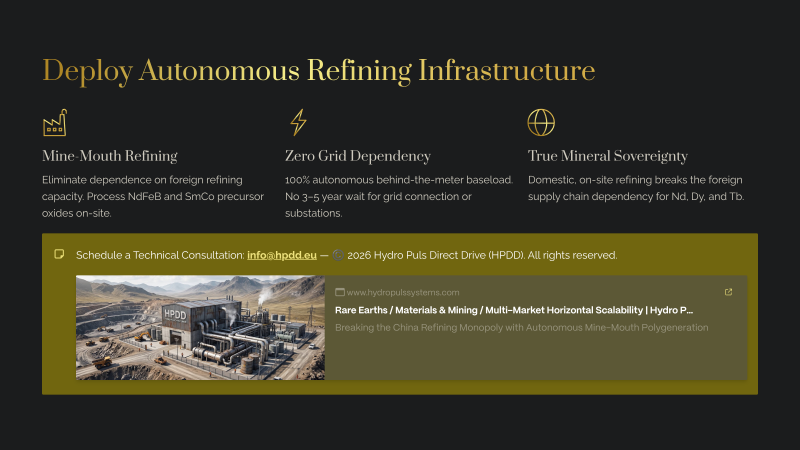
Why the Rare Earth Bottleneck Isn't in the Mines, but in the Thermodynamics
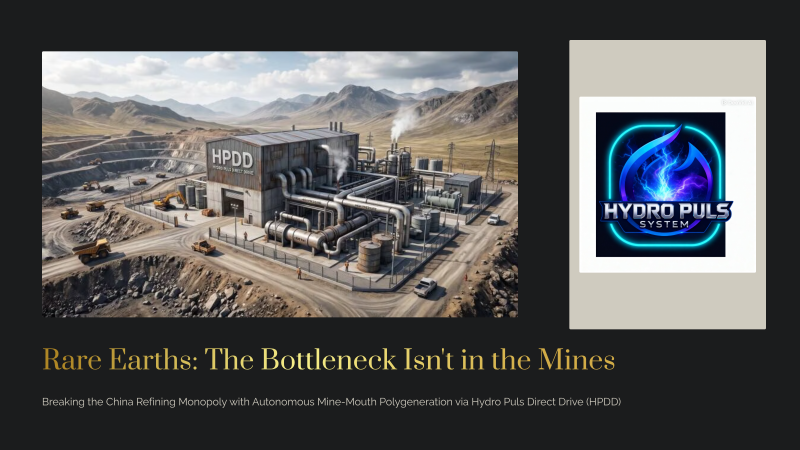
Breaking the China Refining Monopoly with Autonomous Mine-Mouth Polygeneration
1. The Geopolitical Reality: Mines Don't Solve the Crisis
Rare earths are not rare in the Earth’s crust. Deposits exist across North America, Europe, Africa, and Australia.
The bottleneck is downstream refining.
Over 90% of global capacity to refine mixed ores into magnet-grade purities, such as Neodymium (Nd), Dysprosium (Dy), and Terbium (Tb), sits in a single country. Opening new extraction sites simply means mining raw rock only to ship intermediate concentrate right back into foreign supply chains.
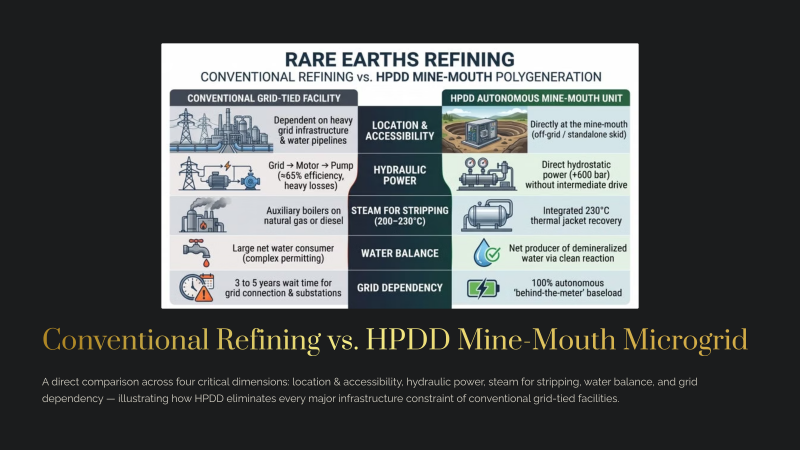
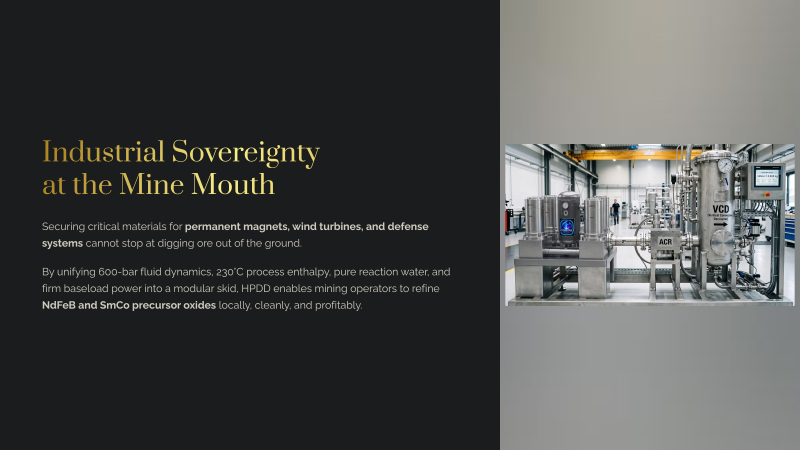
True mineral sovereignty requires domestic, on-site refining at the mine mouth. Yet conventional hydrometallurgy makes off-grid refining virtually impossible under legacy economics.
2. The Hidden Thermodynamic Tax of Solvent Extraction (SX)
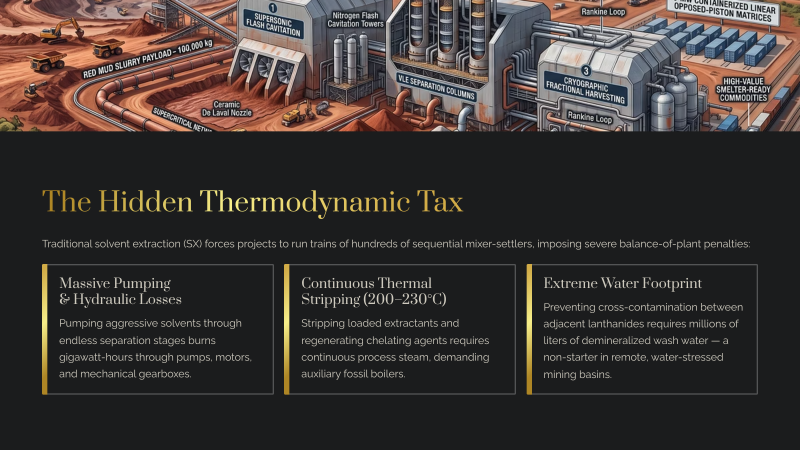
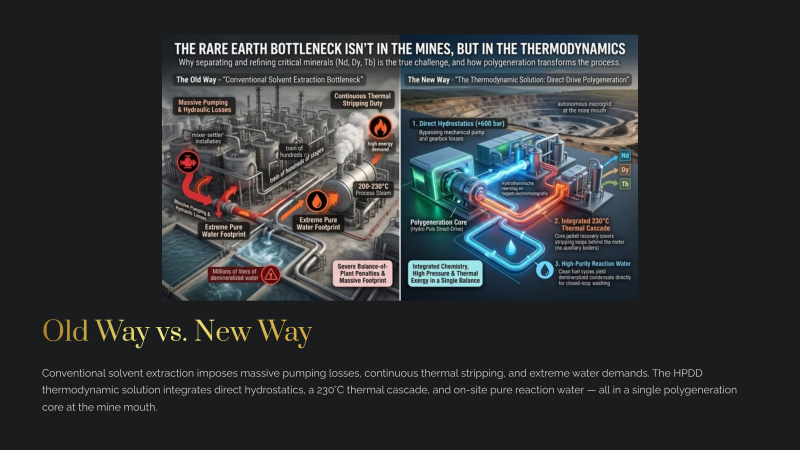
Traditional solvent extraction forces projects to run trains of hundreds of sequential mixer-settlers. This architecture imposes severe balance-of-plant penalties:
* Massive Pumping & Hydraulic Losses: Pumping aggressive solvents and aqueous phases through endless separation stages burns gigawatt-hours through pumps, electric motors, and mechanical gearboxes.
* Continuous Thermal Stripping (200–230°C): Stripping loaded extractants and regenerating chelating agents requires continuous process steam, demanding auxiliary fossil boilers.
* Extreme Demineralized Water Footprint: Preventing cross-contamination between adjacent lanthanides requires millions of liters of demineralized wash water, a non-starter in remote, water-stressed mining basins.
3. The Solution: HPDD Mine-Mouth Polygeneration
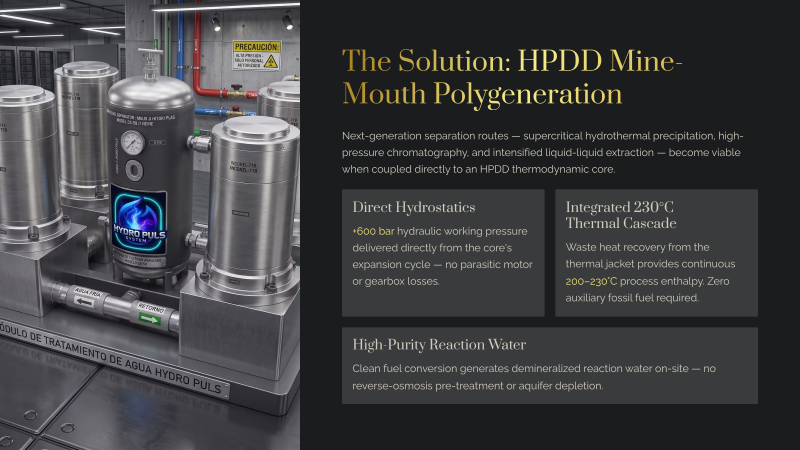
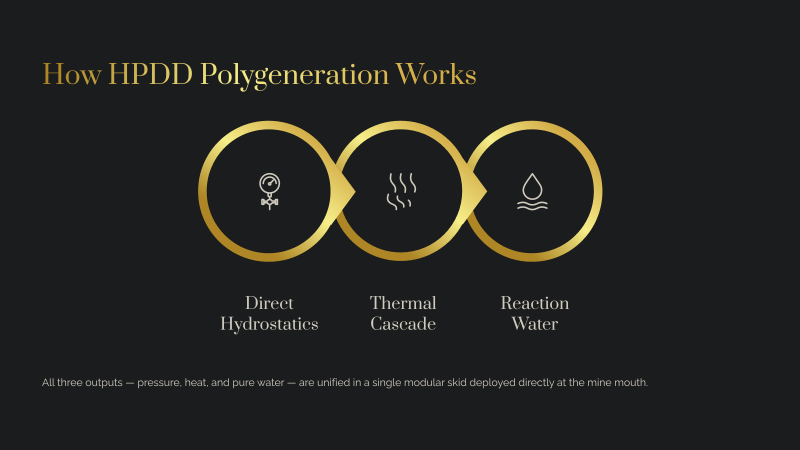
Next-generation separation routes, such as supercritical hydrothermal precipitation, high-pressure chromatography, and intensified liquid-liquid extraction, become viable when coupled directly to a Hydro Puls Direct-Drive (HPDD) thermodynamic core:
Direct Hydrostatics (+600 bar)
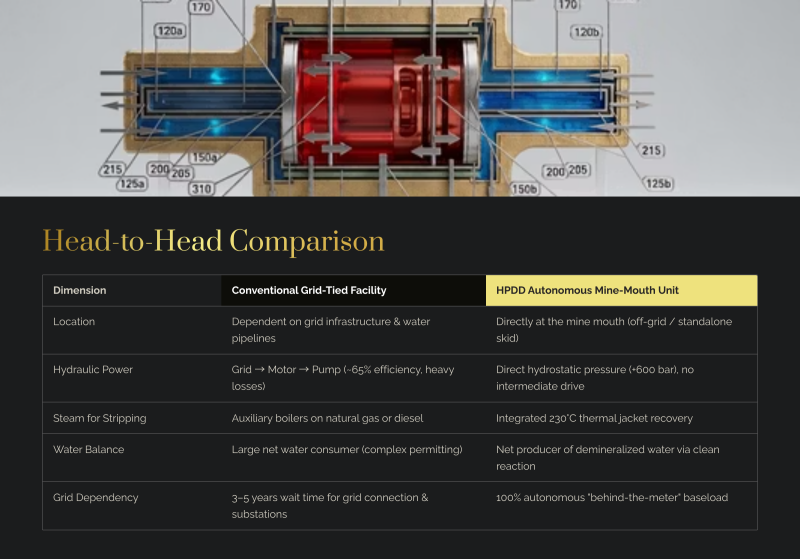
Hydraulic working pressure is delivered directly from the core's expansion cycle. High-pressure columns, ultra-filtration, and dense slurry circuits are driven without parasitic electric motor and gearbox losses.
Integrated 230°C Thermal Cascade
Waste heat recovery from the thermal jacket provides continuous 200–230°C process enthalpy behind the meter. Solvent stripping and chelate regeneration circuits run with zero auxiliary fossil fuel.
High-Purity Reaction Water
Clean fuel conversion - generates demineralized reaction water on-site. Pure wash water is supplied directly to precipitation circuits without reverse-osmosis pre-treatment or local aquifer depletion.
4. Conventional Refining vs. HPDD Mine-Mouth Microgrid