

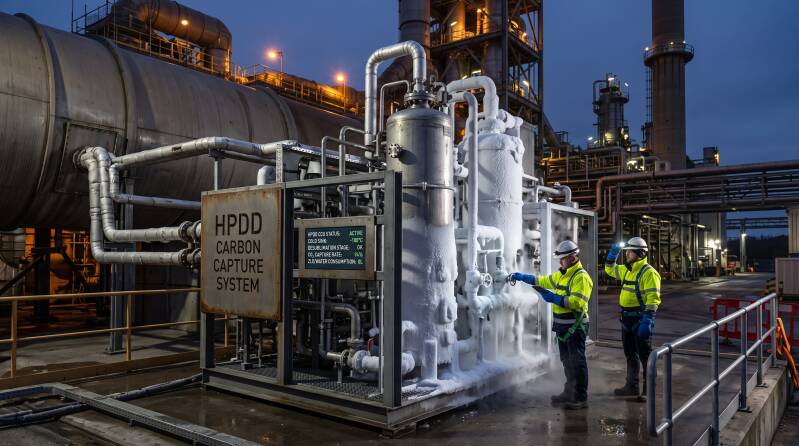
CO2 capture without steam boilers, chemical solvents, or water consumption: the power of direct cryogenic separation.
Conventional carbon capture faces a severe thermodynamic penalty. Amine-based absorption systems require massive amounts of thermal energy just to regenerate chemical solvents:
- Up to 20% to 30% of a plant's total energy output is cannibalized simply to generate low-pressure stripping steam.
- Chemical solvent degradation introduces continuous chemical makeup costs and environmental risks.
- Evaporative cooling towers demand enormous volumes of fresh water in already stressed areas.
Cryogenic Carbon Capture (CCC) offers an elegant physical alternative: freeze the CO2 directly out of flue gas streams as a solid or liquid (sublimation point: -78.5 degrees C). The historic roadblock? The power-hungry, complex external refrigeration compressor trains required to deliver that deep chill.
The HPDD Breakthrough: Direct Desublimation via an Inherent Cold Sink
Hydro Puls Direct-Drive (HPDD) completely rewires the carbon-capture energy balance:
- Inherent -180 degrees C Cryogenic Sink: HPDD generates continuous deep cryogenic cooling as a direct operational byproduct, eliminating the need for dedicated external refrigeration loops.
- Zero Solvents, Zero Steam: CO2 condenses and desublimes cleanly from flue gas streams (cement kilns, steel mills, power plants) purely through phase-change physics.
- True Zero Liquid Discharge (ZLD): No process water consumption, no evaporative cooling towers, and no toxic chemical waste streams.
- Direct Pressurized Liquid CO2: The captured carbon stream can be harvested and pumped directly at transport pressure, primed for sequestration (CCS) or chemical utilization (CCU).
Industrial decarbonization only works at scale if the capture technology doesn't create a massive parasitic energy crisis of its own.
#CarbonCapture #CCUS #Cryogenics #Sustainability #HeavyIndustry #HPDD #CleanTech #Decarbonization