

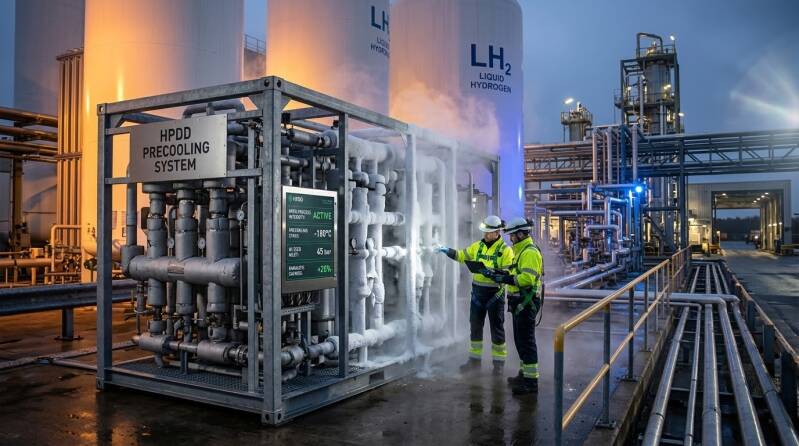
Why liquid hydrogen (LH_2) needs a thermodynamic breakthrough before the liquefaction train.
The hydrogen economy faces a hard physical boundary: liquefaction requires cooling down to -253°C (20 K).
At ambient temperatures, hydrogen has a negative Joule-Thomson coefficient. Simple expansion heats the gas instead of cooling it.
Hydrogen must be precogently precooled well below its inversion temperature (~ -73°C) before final cryogenic refrigeration can even begin.
In conventional liquefaction facilities, this translates to:
* Massive, separate liquid nitrogen (LN_2) refrigeration loops.
* Complex cascaded cycles driven by heavy, rotating compressor trains.
* A parasitic power demand that burns through up to 30% of the energy content of the hydrogen itself.
The HPDD Breakthrough: Direct Precooling to -180°C
Hydro Puls Direct-Drive (HPDD) eliminates this bottleneck directly at the source:
* Inherent Cryogenic Sink: The reactive pulse dynamics yield an immediate -180°C thermal sink as a direct process byproduct, without dedicated external compressor trains.
* Single-Step Precooling: Hydrogen bypasses the inversion boundary in one continuous stage, dropping straight into the deep cryogenic zone ready for the final helium/hydrogen expansion to -253°C.
* Slashing Specific Energy Consumption (kWh/kg): Eliminating the dedicated nitrogen precooling infrastructure removes a major share of parasitic power demand across the plant boundary.
* Modular Skid Deployment: No sprawling cryogenic balance-of-plant; modular, shaftless units deploy directly alongside electrolyser hubs, transport corridors, and marine bunkering terminals.
Liquid hydrogen only becomes economically and thermodynamically viable when we stop burning megawatts simply to prepare the gas for cooling.
#Hydrogen #LH2 #Cryogenics #EnergyTransition #HPDD #CleanTech #Decarbonization #Thermodynamics