

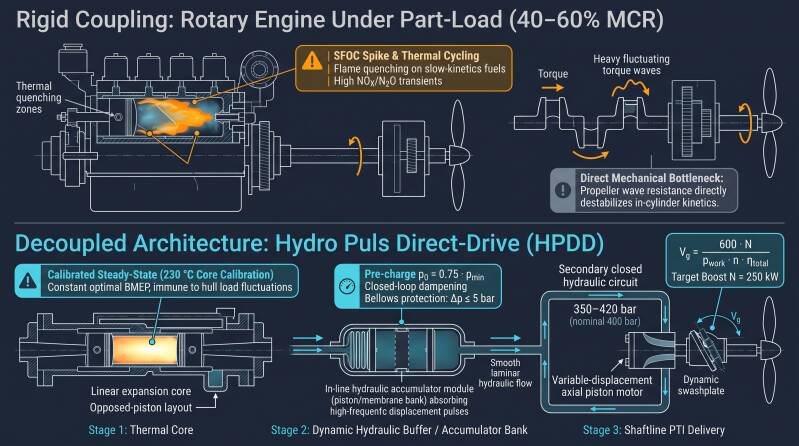
The Part-Load Dilemma: Why Conventional Gensets Falter Outside MCR
In naval architecture, steady-state Maximum Continuous Rating (MCR) is a baseline calculation. In commercial operation, it is an operational myth.
Real-world voyage profiles are defined by sea margins, heavy swells, slow steaming, harbor maneuvers, and fluctuating auxiliary loads. Conventional medium-speed gensets and propulsion engines spend up to 40–60% of their operational life outside their thermodynamic design window.
When burning conventional MGO, part-load operation causes fouling and minor efficiency drops. When burning green ammonia or synthetic fuels costing 2x to 4x more per megajoule, part-load operation becomes an economic disaster:
• Severe SFOC Penalties: Dropping to 40–60% engine load collapses brake mean effective pressure (BMEP). Specific fuel consumption spikes right when you are combusting your most expensive fuel.
• Thermal Shock & Incomplete Kinetics: Alternative fuels with slow laminar flame speeds require stable in-cylinder temperatures. Rapid thermal cycling causes flame quenching, localized hot spots, unburned ammonia slip, and severe NOx/N2O transients.
• Mechanical Throttling Losses: Attempting to match low propeller shaft RPM directly at the crankshaft forces the combustion chamber into low-efficiency, high-wear operating regimes.
---
The Decoupled Architecture: Hydro Puls Direct-Drive (HPDD)
To eliminate the part-load penalty, you must physically decouple thermal gas expansion from propeller shaft dynamics. The Hydro Puls Direct-Drive architecture achieves this through a three-stage hydraulic-mechanical interface:
1. Autonomous Core Thermal Calibration (230 °C Bore Steady-State)
The HPDD linear core never throttles down to match propeller speed. It operates autonomously in its calibrated thermal-mechanical sweet spot, maintaining a constant 230 °C cylinder bore calibration regardless of hull resistance or sea state.
2. Fluid Capacitance & Dynamic Buffering
High-frequency linear displacement pulses are fed directly into an intermediate piston/membrane accumulator bank. Sized with a pre-charge pressure (p0 = 0.75 · p_min), this buffer absorbs transient torque spikes and valve switching dynamics, strictly clamping cyclic differential pressure across sealing bellows within safe boundaries (Δp ≤ 5 bar).
3. Shaftline Power Delivery via Swashplate Angle Modulation
Mechanical boost (N = 250 kW) is delivered to the shaftline or reduction gear via a secondary closed hydraulic loop operating at p_work = 350 - 420 bar (400 bar nominal design).
Torque matching across dynamic sea states is handled entirely by a variable-displacement axial piston motor:
Vg = (600 · N) / (p_work · n · η_total)
(where η_total = 0.92 - 0.95)
Modulating the swashplate angle instantly satisfies shaftline torque and speed (n) demands. The combustion core never experiences the transient shock; it simply delivers continuous volumetric work into the hydraulic capacitor.
Stop forcing combustion chambers to mimic the sea. Keep the thermodynamic core at steady-state, and let high-pressure fluid dynamics manage the waves.
---
For naval architects and fleet superintendents: What percentage of your vessel's actual route profile runs outside 75–85% MCR, and what is that off-design delta costing your fleet on projected alternative fuel pricing?
#MarineEngineering #Decarbonization #MaritimeRetrofit #NavalArchitecture #HydroPulsDirectDrive #MarinePropulsion #FluidPower #Shipping