

From waste emissions to profitable chemistry: why on-site biogenic CO2 valorization is the new industrial benchmark.
Industrial fermentation and distillery operations vent tens of tonnes of pure, biogenic CO2 into the atmosphere every day. In most facilities, this is treated as a regulatory headache or an unrecoverable waste stream. Yet, by pairing that concentrated carbon source with simple brine (sodium chloride), the economics of on-site sodium bicarbonate production shift dramatically.
The engineering and economic reality of a 10 TPD CO2 modular deployment:
- Mass balance: 10 tonnes of biogenic CO2 react with approximately 13.3 tonnes of standard industrial salt (NaCl) to precipitate roughly 19.1 tonnes of technical- or food-grade sodium bicarbonate per day.
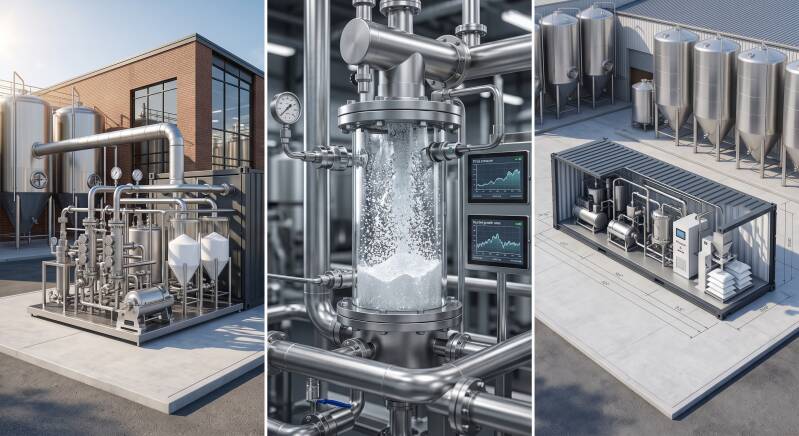
- Replacing legacy columns with containerized skids: Classical Solvay plants require multi-story reaction towers and massive footprint allocations. By applying process intensification via acoustic cavitation and high-shear micro-mixing, the entire gas-dissolution and rapid-nucleation envelope is compressed into a compact, containerized skid.
- Closed loops and dual monetization: The reaction byproduct (ammonium chloride) does not need to become an effluent liability. Concentrating the mother liquor via mechanical vapor recompression (MVR) produces a dry, high-value nitrogen fertilizer, generating two distinct revenue streams while maintaining Zero Liquid Discharge (ZLD).
- Project economics: At current market prices, converting 10 tonnes of vented CO2 delivers significant daily product value, yielding an estimated payback period of under 24 months on modular skid Capex.
Decentralizing chemical synthesis proves that process intensification is more than an emissions abatement tool—it turns localized industrial waste into high-margin baseline commodities right at the source.
#ProcessIntensification #CO2Valorization #CircularEconomy #ChemicalEngineering #ModularSkids #Decarbonization #ZeroLiquidDischarge