

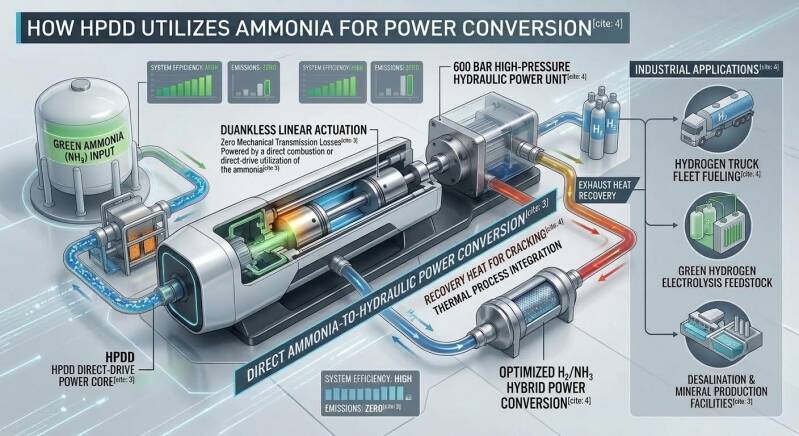
How HPDD Harnesses Ammonia for Direct Fluid Power (Without Crankshafts, External Hydrogen, or Thermal Penalties)
"Ammonia burns far too slowly and is difficult to ignite, how can it deliver high-dynamic fluid power?"
This is the most common and entirely justified question from mechanical and chemical engineers.
Pure ammonia has a low laminar flame speed and a high auto-ignition threshold.
The Hydro Puls Direct-Drive (HPDD) architecture resolves this challenge via in-situ cracking, bypassing traditional combustion bottlenecks.
1. In-Situ Thermocatalytic Cracking (The Internal Hydrogen Accelerator)
Instead of transporting and storing external hydrogen in high-pressure or cryogenic infrastructure, HPDD utilizes its own internal thermal balance:
* Prior to combustion chamber injection, a slipstream of ammonia passes over an internal catalytic cracking core powered by system heat recovery.
* The endothermic cracking reaction splits ammonia on demand:
* This produces an in-situ H_2/NH_3 fuel blend. The liberated hydrogen acts as an instantaneous ignition accelerator with a high flame velocity, ensuring complete, controlled combustion under a 600-bar working envelope.
2. Direct Crankless Linear Actuation (Direct to 600 Bar)
Conventional engine packages route ammonia through an internal combustion engine, a rotating crankshaft, an electric generator, and a hydraulic pump, compounding mechanical and electrical conversion penalties.
HPDD removes all intermediate rotating interfaces:
* Controlled combustion pulses drive opposed piston pairs linearly.
* The linear stroke pressurizes process fluids directly into a continuous 600-bar hydraulic matrix. No crankshafts, no reduction gearboxes, and zero mechanical transmission friction losses.
3. Closed-Loop Process Integration & True Zero Liquid Discharge (ZLD)
The process loop continues beyond kinetic power delivery:
* Controlled high-temperature combustion produces in-situ nitrogen oxides (NO_x) that feed an inline technical nitric acid stream (HNO_3).
* Paired with our Acoustic Cavitation Reactor (ACR), high-frequency pressure shockwaves mechanically shear the tight hydration shells of magnesium ions in raw seawater or high-TDS reject brine.
* This mechanochemical pathway yields solid, commercial-grade magnesium nitrate and ultra-pure water at a negative Levelized Cost of Water (LCOW) under a sealed balance.
By integrating in-situ thermocatalytic cracking directly into a crankless 600-bar core, HPDD turns an operational fuel challenge into a self-sustaining power and mineral extraction platform. No external ignition fuels, no parasitic grid dependencies, and zero waste effluent.