Why the HPDD reactor is not science fiction, but proven industrial physics in a unified architecture.
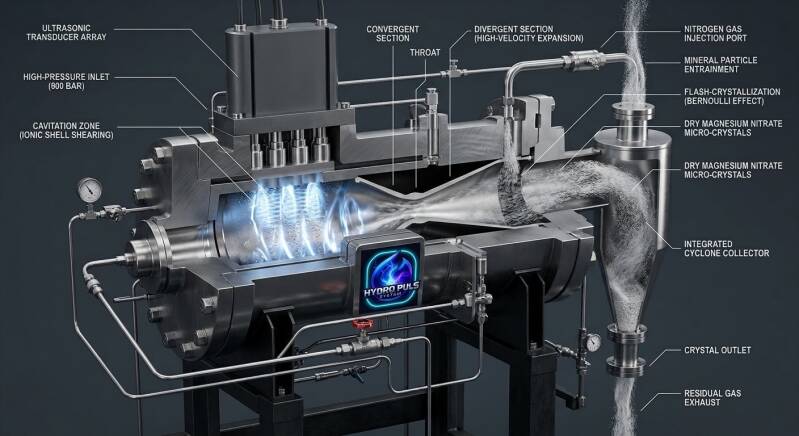
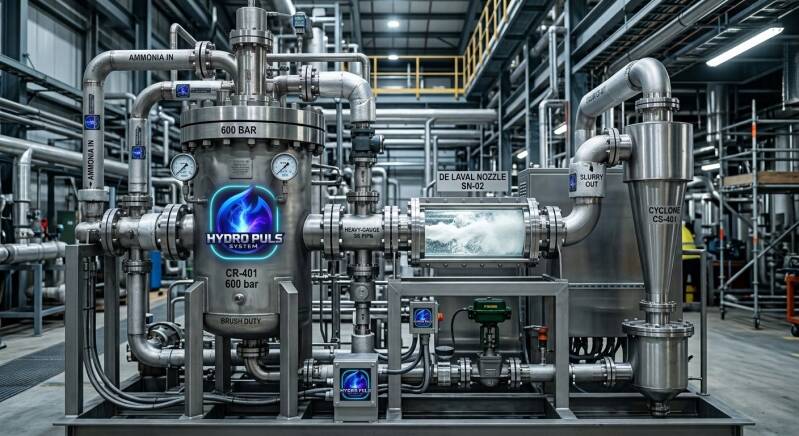
When we explain that we process seawater brine under 600 bar, strip ionic hydration shells with acoustic cavitation, and extract dry mineral crystals using a de Laval nozzle, it can sound like an experimental lab concept.
The reality is far more grounded: every individual physical mechanism in our Acoustic Cavitation Reactor (ACR) has operated commercially in heavy industry for decades.
Consider the core building blocks:
* Supersonic Jet Expansion (de Laval Nozzle): Expanding gas from 600 bar down to 1 bar to entrain particles via the Bernoulli effect and micronize them is identical to the physics used daily in industrial cold spray systems and supersonic jet mills.
* Acoustic Cavitation & Sonochemistry: The pharmaceutical and hydrometallurgical industries have long applied sonocrystallization to narrow metastable zones and break ionic hydration barriers without consumable chemicals.
* Direct High-Pressure Fluid Mechanics: Pumping, displacing, and handling slurries at 600 bar is standard operational procedure in deepwater offshore engineering and high-pressure oil & gas systems.
Where does the actual breakthrough lie?
Not in reinventing individual wheels, but in radically redesigning the integrated system architecture.
Conventional industrial facilities buy isolated, capital-heavy packages: an engine or grid feed for electricity, an enormous boiler for thermal steam evaporation, chemical dosing units, and delicate membrane trains.
Every interface between these machines piles on parasitic conversion losses, balance-of-plant CAPEX, and severe maintenance overhead.
The Hydro Puls Direct-Drive (HPDD) platform merges these steps into a single thermodynamic loop:
* Direct Mechanical Transfer: Direct-drive combustion of clean energy carriers (such as ammonia) drives displacement pistons immediately, bypassing crankshafts, transmissions, and electrical conversion steps.
* Chemical Self-Sufficiency: Ammonia combustion delivers the in-situ nitrogen oxides (NO_x) required to form technical nitric acid on-site, reacting with magnesium to crystallize magnesium nitrate without an external acid logistics chain.
* Eliminating the Evaporator: Instead of boiling off megawatts of steam to precipitate salts, high-energy acoustic cavitation and supersonic gas expansion separate the mineral crystals mechanically under ambient thermal conditions.
The result is not an expensive, high-risk science project, but an exceptionally cost-effective industrial asset.
By turning high-TDS reject brine into commercial-grade fertilizers and ultra-pure water with a negative Levelized Cost of Water (LCOW), we prove that industrial decarbonization can be immediately bankable.
The physics and components have proven their endurance across global plants for decades.
We simply connected them the way first-principles thermodynamics intended.