

Why does heavy industry continue to accept that conventional engines and steam turbines vent two-thirds of their input energy straight into the atmosphere?
Internal combustion engines and traditional turbines are still anchored to 19th-century mechanical architecture. The outcome is well known: massive thermal waste, toxic exhaust emissions, parasitic friction, and complex cooling loops consuming millions of liters of water.
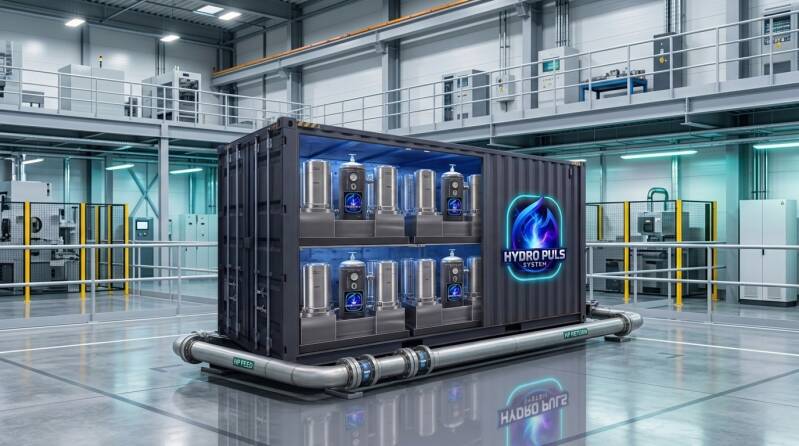
The Hydro Puls Direct-Drive (HPDD) platform fundamentally breaks this thermodynamic limitation.
Instead of open combustion, HPDD executes a direct conversion of ammonia into 600-bar hydraulic power:
- No open combustion & no exhaust stack: The chemical release is sealed, isolated, and precisely managed.
- Zero cooling water & no external chillers: The thermodynamic cycle manages its thermal profile internally.
- Zero friction & zero lubricating oil: Eliminating mechanical drive linkages prevents oil degradation and fluid contamination.
- Near-zero moving parts: Crankshafts, camshafts, connecting rods, and mechanical transmissions are completely removed.
Turning Waste Heat into Feedstocks
Where antique systems discard 66% of their fuel value as hot exhaust gas, HPDD cleanly separates the reaction products into pure water and high-grade nitrogen. Rather than being lost to the air, these streams are immediately recaptured on-site for chemical synthesis, inert blanketing, or downstream industrial processes.
Thermodynamic Efficiency Meets Radical Profitability
Decarbonization succeeds when the economics are undeniable. HPDD eliminates parasitic conversion steps, avoids grid transmission losses, and slashes maintenance overhead. In targeted industrial operations, this direct fluidic architecture delivers a full return on investment (ROI) within just 3 months.
It is time to stop venting two-thirds of our energy into the air. The future of industrial baseload power is closed, fluidic, and direct.
#CleanTech #ProcessEngineering #HPDD #AmmoniaEconomy #EnergyEfficiency #Decarbonization #Fluidics #IndustrialInnovation #CircularEconomy #ZeroEmission