

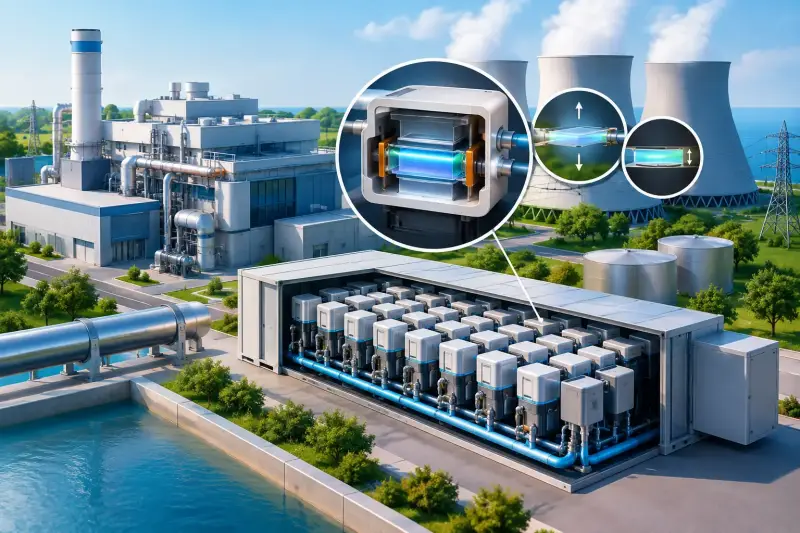
Top Power Plant Retrofit Technologies for 2026
A power plant does not become obsolete when its original turbine reaches a performance ceiling.
It becomes obsolete when its heat, pressure, electrical interconnection, water systems, and site footprint can no longer produce enough economic value. The top power plant retrofit technologies address that gap by turning existing thermal infrastructure into a more flexible, lower-emissions, multi-output industrial asset.
1. High-Efficiency Turbine and Generator Upgrades
Modern blade profiles, upgraded steam paths, advanced coatings, and generator rewinds recover lost capacity and reduce heat rate. However, these provide incremental improvements within an existing thermodynamic cycle without eliminating underlying part-load or cooling water constraints.
2. Combined Heat and Power (CHP) Conversion
Many stations reject valuable thermal energy through cooling towers and exhaust stacks. Converting to CHP captures this enthalpy for district networks, industrial steam, greenhouses, or desalination. Economic success requires a predictable, co-located thermal off-taker to avoid heavy piping and distribution losses.
3. Carbon Capture and Flue-Gas Conditioning
Post-combustion carbon capture is becoming standard for cement kilns, refining, and dispatchable assets. However, solvent regeneration and gas compression impose heavy parasitic energy penalties. Viable projects must integrate heat recovery and power-island upgrades to offset this auxiliary load.
4. Hydrogen and Ammonia Fuel Conversion
Co-firing or converting to clean fuels extends asset life. Hydrogen introduces high flame speeds, low ignition energy, and flashback risks. Ammonia presents ignition and slip challenges, but offers superior transport and storage economics. A staged fuel-blending strategy protects capital while supply chains mature.
5. Direct-Drive Thermal Architectures (HPDD-NEXUS)
Conventional rotating equipment incurs steep efficiency penalties under part-load conditions. The Hydro Puls Direct Drive (HPDD-NEXUS) architecture decouples energy generation from variable industrial demand.
Pulse-based isolated combustion allows the thermal core to run steadily at its optimal operating point, while high-pressure hydraulic transfer directly drives pumps, compressors, and generators. Serving as a modular "Autonomous Energy Heart," it complements or replaces aging steam-turbine functions and eliminates rotating drivetrain losses.
6. Thermal Storage, Batteries, and Hybrid Dispatch
Battery storage delivers sub-second frequency response, while thermal storage preserves surplus steam or hot fluids for process heat. Hybridizing these elements with a dispatchable thermal or direct-drive core provides long-duration resilience across variable power markets.
7. Advanced Digital Plant Optimization
Sensors, digital twins, and automated dispatch optimize combustion dynamics, bearing temperatures, and auxiliary loads.
While software cannot fix mechanical under-design, it prevents forced downtime and highlights where physical retrofits deliver peak returns.
An aging facility shifts from a legacy liability to a high-margin asset when owners evaluate system-wide boundaries, monetizing power, usable heat, cooling, freshwater, and direct mechanical work in a single framework.