🚀 Maritime Propulsion Innovation: The ‘Needle Thruster System’
Conventional pod drives face an inherent hydrodynamic dilemma: parasitic form drag caused by an oversized underwater nacelle.
Stuffing heavy electric motors or geared generator assemblies directly into the submerged casing demands a bulky pod body, generating turbulence and penalizing propulsive efficiency.
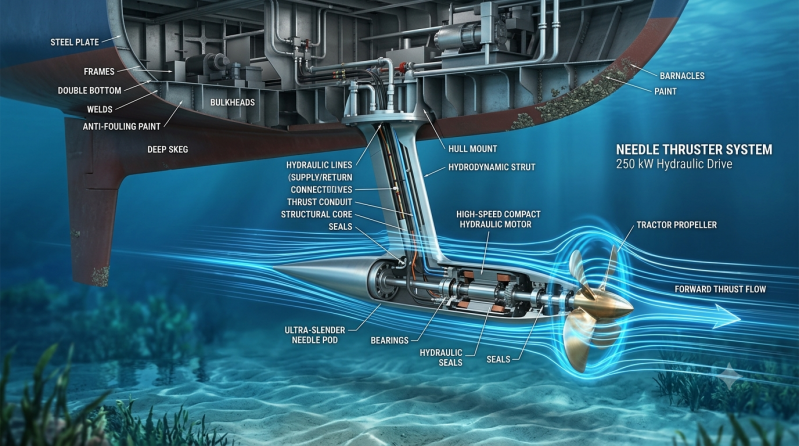
The Needle Thruster System fundamentally re-engineers this layout through a decoupled power-transmission architecture.
🔹 The Core Concept: Decoupled Architecture
Instead of packing all drive machinery into the water flow, the system physically separates high-mass power generation from low-profile thrust delivery:
* Inside the Vessel Hull (Hydro Puls Direct-Drive — HPDD):
* Two pairs of horizontally opposed pistons neutralize primary linear inertia forces internally, ensuring completely vibration-free operation within the hull structure.
* The HPDD functions as the centralized hydraulic pulse source, supplying siloxane working fluid at +600 bar and an operating baseline of 230 °C.
* Matched Inconel-on-Inconel thermal expansion (both expanding by exactly 109 µm at 230 °C) maintains a tight 5 µm running clearance, virtually eliminating volumetric blow-by at high pressures.
* Through the Hydrodynamic Strut:
* No heavy mechanical drive shafts, bevel gears, or bulky electric cables. The strut serves solely as a structural conduit carrying high-pressure delivery and return lines.
* This allows for an ultra-thin symmetrical foil section, drastically cutting profile drag and vortex shedding during steering angles.
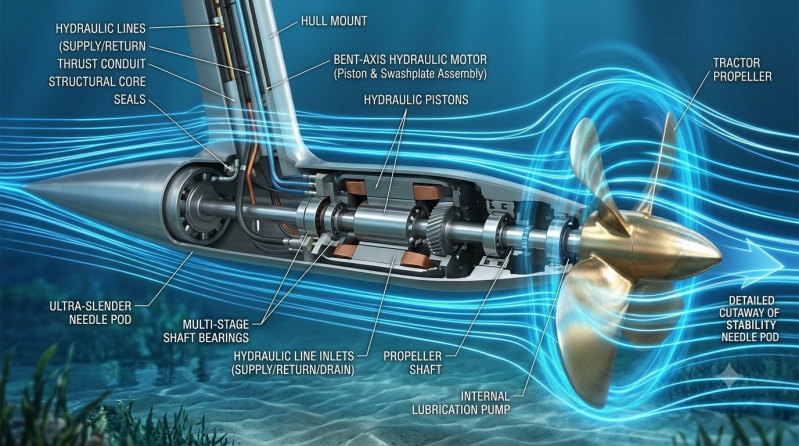
* Submerged (The Needle Tractor Pod):
* The underwater housing contains only an ultra-compact bent-axis hydraulic motor coupled straight to the forward tractor propeller.
* Because the casing diameter barely exceeds the propeller hub itself, the system approaches an optimal hub-to-tip ratio.
* Running in unperturbed, uniform inflow ahead of the strut, the tractor propeller mitigates cavitation risk, cuts wake turbulence, and optimizes overall thrust output.
💡 Key Engineering Advantages
* Radically Reduced Wetted Area: The frontal cross-section of the pod is trimmed down to the bare mechanical minimum.
* Smart Thermal Boundary Management: The surrounding seawater provides passive cooling for the submerged hydraulic motor, while high-temperature operations (230 °C) remain fully contained and managed within the engine space.
* High-Frequency Scalability: Built to scale toward 200 Hz and 160+ kW. Because power scaling is achieved via frequency and volumetric flow rather than physical motor displacement, the submerged pod remains needle-slender as capacity climbs.
The Needle Thruster System demonstrates that achieving peak hydrodynamic efficiency starts by questioning where powertrain mass belongs. Less underwater frontal area, maximum thrust.
What are your thoughts on decoupled hydraulic pulse transmission versus direct-electric pod pods for future commercial and naval hulls?
Let's discuss in the comments! 👇
#MaritimeEngineering #Hydrodynamics #PropulsionInnovation #NavalArchitecture #MarineTechnology #GreenShipping