

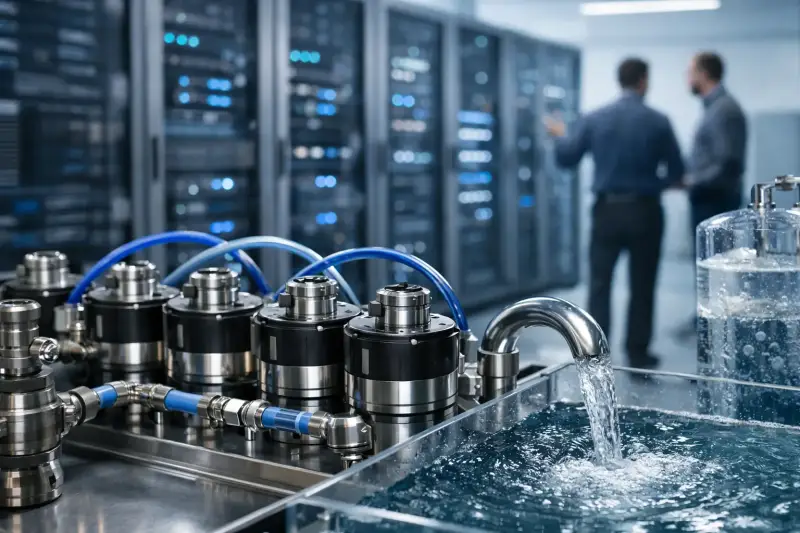
Water is becoming a limiting design variable for data center expansion. In water-stressed markets, a project can have interconnection capacity, land, and customers, yet still face delays because its cooling design depends on municipal water or evaporative loss. This data center water recovery example examines a different starting point: treat water, cold, and power as coupled outputs of the energy architecture rather than separate utility problems.
The distinction matters. A conventional facility often buys electricity, rejects heat through a cooling system, and then adds water treatment to reduce the impact of cooling. That can lower water use, but it does not change the underlying thermodynamic arrangement. A direct-drive energy core can instead create an opportunity to produce usable cold, generate water within the process where fuel chemistry permits it, and apply hydraulic power directly to critical balance-of-plant equipment.
Data center water recovery example: start with the energy core
Consider a modular data center deployment where the primary objective is not merely to reduce cooling-tower makeup water. The objective is to establish an autonomous utility island capable of delivering electrical generation, low-temperature cooling potential, hydraulic work, and recoverable water from a single integrated platform.
In the Hydro Puls Direct Drive architecture, pulse-based isolated combustion transfers energy hydraulically instead of routing it through a conventional crankshaft-driven engine train. The system is designed to operate continuously near its preferred operating condition while electrical demand, pumping duty, fan speed, and thermal loads are managed at the system boundary. This separation between energy conversion and variable load is central to the water case. It reduces the pressure to follow every IT-load movement with inefficient partial-load mechanical operation.
For data center planners, the practical implication is direct: cooling and water recovery should be modeled alongside generation from the first feasibility study. They should not be left to a later mechanical package selection after the electrical architecture is frozen.
Why the conventional water loop reaches a limit
Most conventional water strategies focus on better versions of an existing loop. Operators may increase cycles of concentration, reclaim blowdown, use non-potable supply, install side-stream filtration, or move from water-cooled to air-cooled chillers. Each measure has value, but each has a trade-off.
Air cooling can sharply reduce site water withdrawal, yet it often increases electrical demand and can lose capacity during high ambient conditions. Evaporative cooling can deliver favorable thermal performance, but it creates ongoing dependence on water quality, treatment chemicals, discharge management, and local supply certainty. Reclaimed-water connections reduce potable demand but may introduce availability, corrosion, and permitting constraints.
A recovery-first architecture does not eliminate these engineering decisions. It changes the available inputs. The site is no longer limited to asking how much water its cooling system consumes. It can ask how much process water it can condition, store, reuse, and displace within an integrated energy and thermal system.
The operating case: cold, power, and water in one plant boundary
Hydro Puls Systems specifies that an HPDD data center configuration can supply a cold stream equivalent to -73°C, 396 kW/hour of cold production, 4,158 liters of fresh water per hour, and hydraulic power for generators, pumps, and fans. Those figures establish the scale of the opportunity, but they are not a substitute for a project mass balance. A deployment team must validate output at the selected fuel, ambient condition, operating hours, water-treatment configuration, and redundancy level.
The cold stream is especially significant because it can be used to reshape the cooling train. Rather than relying entirely on electrically driven compression chillers and evaporative heat rejection, the design can use available low-temperature potential for staged cooling, thermal storage, process conditioning, or localized high-density compute cooling. The best configuration depends on the data hall temperature envelope, rack density, and whether the site uses air, direct-to-chip liquid, or immersion cooling.
The water output requires equally careful treatment. Water formed in combustion or recovered from process streams is not automatically data-center-grade water. It may require condensation, separation, polishing, demineralization, disinfection, storage, and continuous quality monitoring before it can enter a cooling loop or any sensitive application. The engineering advantage is not that treatment disappears. It is that the plant has a new water source inside its own operating boundary.
Fuel choice also matters. Hydrogen combustion produces water as a primary reaction product. Hydrocarbon fuels also generate water, though carbon management and exhaust treatment remain part of the system equation. Ammonia contains no hydrogen and therefore does not create water through ammonia combustion alone. An ammonia-ready platform can still participate in a water strategy through integrated atmospheric extraction, reverse osmosis, or other recovery processes, but its water balance must not be represented as identical to a hydrogen-fueled case.
Build the water balance before selecting equipment
A credible data center water recovery example begins with hourly flows, not an annual sustainability claim. The calculation should distinguish water produced, water recovered, water treated, water stored, water consumed, water discharged, and water lost to evaporation. It should also identify which streams are suitable for cooling makeup, washdown, process duty, or require further polishing.
For a system rated at 4,158 liters per hour of fresh-water production, continuous operation would indicate a theoretical gross volume of almost 100,000 liters per day. The usable volume will be lower after commissioning allowances, treatment losses, maintenance intervals, storage turnover, and site-specific reliability margins. Still, even a fraction of that volume can materially change cooling-water procurement and resilience planning where supply is constrained.
The design team should then compare that recovered-water volume against the selected cooling topology. A direct-to-chip liquid-cooled facility may require much less water than a legacy evaporative cooling design. A site using thermal storage may shift cooling duty to periods when the energy core is operating at its preferred condition. A hybrid system may retain a cooling tower for extreme weather or contingency operation while using recovered water to reduce normal makeup demand.
This is where architectural superiority becomes economic value. If the same energy core delivers generation, cold, hydraulic work, and a recoverable water stream, fewer isolated systems must be sized, powered, maintained, and backed up independently.
Where the economics change
Water recovery is often evaluated only as a utility-cost offset. That is too narrow for large digital infrastructure. The financial case includes avoided water purchase, reduced wastewater exposure, lower dependence on trucked emergency supply, potential relief from connection constraints, and a more bankable pathway in jurisdictions where water availability influences permitting.
The larger value may be operational. A data center cannot treat cooling water as an inexpensive commodity if its availability can constrain expansion or interrupt capacity. On-site recovery creates a buffer against supply volatility when paired with adequately sized storage and treatment redundancy. It does not make a facility independent of all outside utilities, but it can reduce a critical single-point dependency.
There are trade-offs. Water polishing equipment adds capital cost and operating discipline. Tanks occupy space. Sensors, sampling, and treatment chemicals require maintenance. In some locations, low-cost municipal water and a favorable air-cooling climate may make recovery less compelling as a pure cost measure. In high-density, water-constrained, or remote deployments, the resilience and permitting benefits can outweigh those additions.
Engineering gates before deployment
Before specifying an integrated water-recovery plant, project teams should resolve five questions:
- What is the hourly water demand under normal, peak, and contingency cooling conditions?
- What fuel pathway will be used at commissioning and after transition to hydrogen or ammonia-ready operation?
- What recovered-water quality is achievable, and what polishing train is required for each end use?
- How will cold production interface with the facility's selected cooling distribution system and redundancy philosophy?
- What storage volume is required to bridge maintenance, water-quality excursions, and utility interruptions?
These gates force the right disciplines into the same room: energy engineers, mechanical designers, water-treatment specialists, operations teams, and data center reliability leads. They also prevent a common mistake: treating a gross water-production number as guaranteed usable cooling water without defining quality, storage, and operating conditions.
A different standard for water-resilient compute
The strongest data center water strategy is not a bolt-on conservation program. It is an energy architecture that recognizes water as a co-product, cold as a strategic resource, and hydraulic power as a direct route to useful industrial work. Hydro Puls Systems is advancing that model through the HPDD Autonomous Energy Heart, designed to replace or work alongside conventional generation and thermal infrastructure.
For developers facing constrained water allocations, rising power demand, and pressure to build capacity without expanding environmental exposure, the next feasibility study should begin with one question: how much of the site's water and cooling burden can be designed out before the first tower, chiller, or utility connection is specified?