

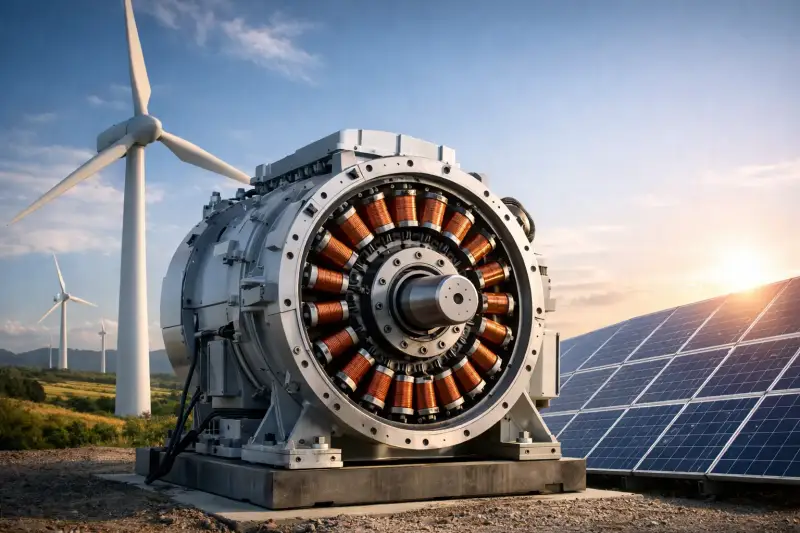
A conventional engine spends much of its life converting fuel into motion, then converting that motion again through shafts, gears, generators, pumps, and control layers before useful work is finally delivered. Every intermediate step adds friction, heat rejection, parasitic drag, and operating compromise. That is exactly why the question what is direct drive power generation matters to serious industrial buyers. It is not a semantic distinction. It is an architectural one.
What is direct drive power generation?
Direct drive power generation is a system architecture in which the prime mover transfers energy to the output stage with minimal mechanical conversion between source and useful work. In plain engineering terms, it means reducing or eliminating intermediary components such as crankshafts, complex gear trains, belt systems, or multi-stage transmissions that traditionally sit between combustion and power delivery.
The objective is straightforward. Fewer conversion steps mean fewer losses. But the strategic value runs deeper than efficiency alone. A true direct-drive architecture can stabilize operating conditions, reduce wear points, improve controllability, and make it easier to match the energy core to the application rather than forcing the application to conform to the limitations of legacy machinery.
In industrial practice, direct drive can describe several different system types. A wind turbine may use a low-speed generator without a gearbox. A motor may drive a load directly rather than through a transmission. In advanced thermal systems, the term becomes more significant: it refers to generating usable hydraulic, electrical, or mechanical output through a tightly coupled energy path that avoids the traditional crank-driven engine model.
Why direct drive changes the thermodynamic picture
Standard engine architecture is full of inherited compromises. Combustion pressure acts on pistons, pistons rotate a crankshaft, the crankshaft drives a generator or pump, and the load side fluctuates continuously. That sequence introduces side loads, vibration, frictional losses, transient inefficiencies, and control penalties. It also forces the thermal machine to follow the behavior of the external load.
Direct drive changes that relationship. Instead of treating the engine as a mechanically entangled device, it treats the energy core and the work output as an engineered coupling problem. If the conversion path is shorter and more controlled, more of the original energy can be preserved for productive output.
This matters because industrial systems rarely fail on nameplate power alone. They fail on efficiency erosion, maintenance burden, unstable duty cycles, poor part-load performance, and the inability to integrate multiple outputs such as electricity, heat, pressure, pumping work, or propulsion from one coherent platform.
A direct-drive system can be designed to operate closer to an idealized performance zone, where combustion, pressure generation, and energy transfer remain stable even when the external demand varies. That is a major departure from conventional reciprocating systems, which often spend real operating hours chasing a moving target.
What direct drive power generation looks like in real systems
The phrase direct drive does not always mean the same hardware, so precision matters. In electrical rotating equipment, direct drive often means a motor or turbine rotor directly coupled to a generator with no gearbox. The gain is lower maintenance and reduced drivetrain loss, although the trade-off can be larger machine size and more demanding torque design.
In hydraulic or thermal-hydraulic systems, direct drive can mean something more advanced. Instead of using combustion to spin a crankshaft first, the system generates pressure in a controlled chamber and transfers that energy directly into hydraulic work, linear motion, or closely coupled generation modules. That architecture removes some of the most persistent inefficiencies found in conventional engines: mechanical side loading, crank geometry losses, and dependency on rotational linkage as the default pathway.
This is where category boundaries start to shift. The most advanced platforms are no longer best described as engines in the classic sense. They behave more like thermal transformers - systems that convert fuel energy into controlled, application-ready output through a cleaner chain of causality.
The core engineering advantage: fewer parasitic losses
Parasitic losses are the silent tax in every power plant, transport platform, and industrial energy package. Bearings consume energy. Gear meshes consume energy. Oil pumps, cooling loads, valve-train motion, rotating inertia, and transmission drag all consume energy. Each one may look acceptable in isolation. Together, they define the practical ceiling of system performance.
Direct drive power generation attacks that loss stack at the architectural level. It does not ask how to optimize each penalty after the fact. It asks why those penalties exist in the first place.
That distinction is critical for capital-intensive sectors. If a system can reduce moving interfaces, maintain more stable chamber conditions, and couple output directly to the required industrial function, the result can be lower fuel consumption, higher net efficiency, and a simpler maintenance profile. The exact gain depends on the application, duty cycle, fuel, and output form. There is no single universal number. But the design logic is sound and increasingly relevant as operators look for every percentage point of efficiency under tighter cost and emissions pressure.
What is direct drive power generation not?
It is not merely a marketing label for any generator attached to an engine. And it is not automatically superior in every use case.
Some applications still benefit from conventional rotating architectures, especially where supply chains, operator familiarity, low upfront cost, and standardized service networks outweigh efficiency gains. A direct-drive system can also demand more specialized controls, different packaging assumptions, and a stronger integration strategy at the project level.
That is why serious evaluation should focus on the full system boundary. How is energy created? How is it transferred? How many conversion stages sit between fuel input and useful output? How stable is operation across load variation? What happens under thermal cycling? What maintenance interfaces are removed, and which new ones are introduced?
If those questions are not answered, the term direct drive is being used too loosely.
What is direct drive power generation in next-generation thermal systems?
In next-generation thermal systems, direct drive power generation means decoupling combustion from the inherited mechanics of the crankshaft era. Instead of forcing thermal energy through rotational machinery first, the architecture is built around controlled pressure generation and direct energy transfer to the required output domain.
That output may be electricity, hydraulic power, combined heat and power, marine propulsion, heavy transport motion, industrial process energy, or integrated multi-output service from a single autonomous energy core. The strategic advantage is not only that energy takes a shorter path. It is that the energy core can be engineered to remain in a preferred operating band while downstream demand is managed separately.
For industrial buyers, this has major implications. Constant-condition operation can improve thermal consistency, efficiency retention, emissions management, and component life. Fuel flexibility can also improve because the platform is not tied as tightly to the dynamic instability of conventional engine response. That creates a more credible path for systems that need to work today on conventional fuels and tomorrow on hydrogen, ammonia, or blended energy carriers.
This is the logic behind advanced architectures such as Hydro Puls Systems' direct-drive platform, which frames the power core not as another engine variant but as a new thermodynamic machine class. That distinction matters because once direct coupling, isolated combustion behavior, and hydraulic energy transfer are designed as the primary architecture rather than as add-ons, the optimization window changes materially.
Where direct drive power generation delivers the most value
Direct drive is most compelling where efficiency, reliability, and output flexibility are worth more than mechanical familiarity. Combined heat and power is an obvious case because every incremental point of fuel utilization has recurring economic value. Off-grid and remote power applications also benefit because maintenance logistics and fuel delivery costs are punitive. Heavy-duty transport, shipping, greenhouse energy, desalination, defense systems, and industrial microgrids are similarly strong candidates when operators need stable power cores with multiple usable outputs.
That said, value is application-specific. A site with highly variable electrical loads but strong thermal demand may prioritize controllability and heat recovery. A propulsion system may prioritize torque response and packaging. A hydrogen-ready infrastructure project may care most about future fuel transition without replacing the entire energy platform. Direct drive is not one benefit. It is a way of preserving optionality while reducing structural loss.
The real reason this question matters now
The energy market no longer rewards machines simply for running. It rewards systems that convert more, waste less, adapt faster, and integrate cleanly into changing fuel and regulatory environments. That raises the bar beyond incremental engine improvement.
So what is direct drive power generation? At its best, it is the replacement of a mechanically inherited compromise with a first-principles energy architecture. It reduces the distance between energy release and useful work. It creates room for higher efficiency, lower parasitic loss, and better multi-output integration. And for industries under pressure to decarbonize without surrendering reliability, that architectural shift may prove more important than any isolated component upgrade.
The right question is no longer whether direct drive sounds innovative. It is whether your current power architecture is still wasting too much energy just to keep itself moving.