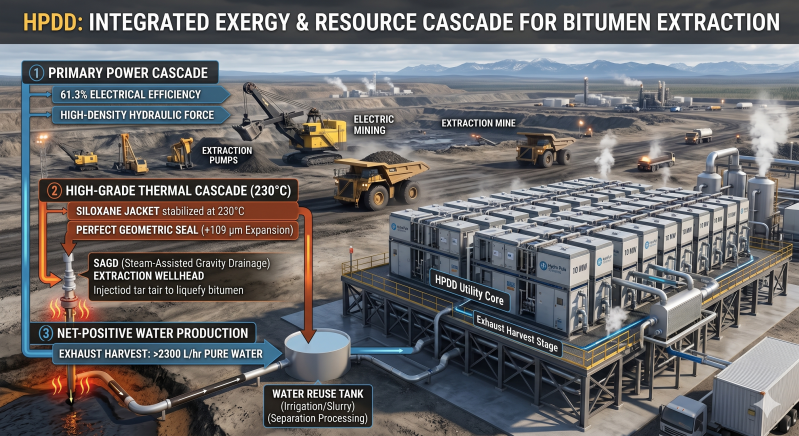
Zero-Emission Bitumen & Oil Sands Mining

This application is in collaboration with Professor Mohamed Amin - Associate Professor at Al-Azhar University , Rutgers University, USA, University of Debrecen, Hungary.
His knowledge and experience in these fields has led to this discovery and application.
Zero-Emission Bitumen & Oil Sands Mining
Redefining the Thermodynamic Boundaries of Heavy Industry via Molecular Phase Disengagement
Traditional bitumen and oil sands extraction represents one of the most energy-intensive, environmentally damaging processes in the world. Burning massive volumes of natural gas simply to generate low-pressure steam for Steam-Assisted Gravity Drainage (SAGD) represents a catastrophic destruction of raw exergy.
The Hydro Puls Direct-Drive (HPDD-NEXUS) architecture, integrated with Professor Mohamed Amin’s molecular isolation kinetics, introduces a definitive paradigm shift. By moving operations from legacy mechanical washing to a software-defined, crankshaft-free linear energy core, the platform processes heavy hydrocarbon aggregates natively at the material face.
The system collapses extraction, high-density power generation, and carbon harvesting into a highly synchronized, zero-emission triple-asset cascade. It turns traditional environmental liabilities directly into a bankable, recurring commodity flow under an Energy-as-a-Service (EaaS) infrastructure leasing framework.

🚨 THE BOTTLENECK
The Exergy Crisis & Boundary Layer Limitations in Heavy Mining
In conventional mining and SAGD setups, multi-megawatt utility blocks burn fossil feedstocks strictly for thermal liquefaction]. This instantly downgrades high-grade chemical energy directly into low-temperature heat without extracting any primary physical work first].
Furthermore, traditional extraction hits an insurmountable physical boundary: the high interfacial tension between viscous bitumen and silica sand grains. Attempting to separate these phases using massive volumes of hot freshwater slurry creates vast tailings ponds, inflicts severe pipeline scaling, and forces heavy grid dependencies that continually erode utility operating margins.
The HPDD platform completely eliminates these constraints by collapsing extraction kinetics, thermal cascading, and water reclamation into a single machine footprint
⚡ THE MOLECULAR INTENSIFICATION PROCESS
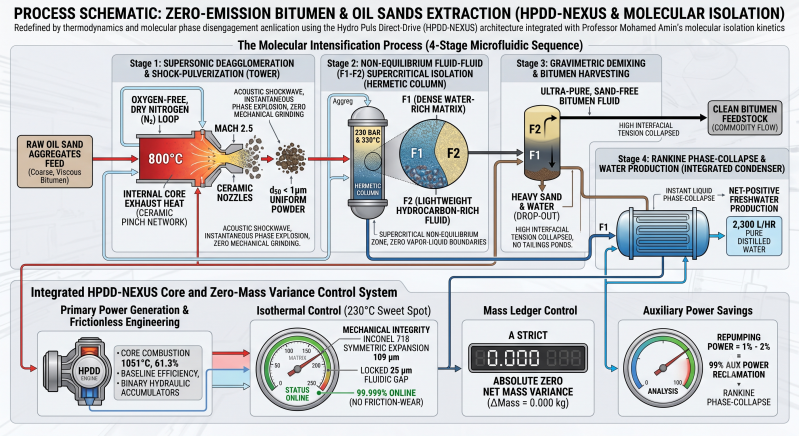
The system handles raw oil sand and bitumen matrices through a precise, 4-stage microfluidic transport sequence:
💥 1. Supersonic Deagglomeration & Interfacial Shock-Pulverization
Raw, coarse oil sand aggregates are fed directly into our sealed processing tower. An oxygen-free, bone-dry inert Nitrogen gas loop is compressed to 600 BAR and superheated to 800°C by capturing internal engine core exhaust heat within our ceramic Pinch Heat Integration Network.
Expanding this fluid past Mach 2.5 through specialized ceramic nozzles generates a continuous acoustic shockwave. The microsecond the aggregate meets this supersonic blast, it undergoes an instantaneous isentropic decompression phase explosion. The aggregate is shattered from within, reducing the material to a uniform sub-micron powder morphology (d50< 1µm) in milliseconds. This completely collapses the physical boundary layers holding the bitumen to the sand, bypassing mechanical grinding and dust explosion hazards entirely.
🔄 2. Non-Equilibrium Fluid-Fluid (F1-F2) Supercritical Isolation
The pulverized sub-micron aggregate enters our hermetic phase-isolation column maintained at an automated threshold of 230 BAR and 330°C. At this exact thermodynamic coordinate, the water-hydrocarbon-carbon system enters a highly optimized Supercritical Fluid-Fluid (F1-F2) Non-Equilibrium Phase Demixing Zone.
Because both the processing fluids and target elements have exceeded their respective critical points, traditional vapor-liquid boundaries vanish. The compounds split into two distinct, coexisting phases right beside each other: a dense, water-rich matrix (F1) and an ultra-lightweight, high-purity hydrocarbon-rich fluid matrix (F2).
⚖️ 3. Gravimetric Demixing & Clean Bitumen Harvesting
Exploiting the vast density gap at this supercritical threshold, the heavy sand particles and water-rich fractions undergo an immediate gravimetric drop, sinking cleanly to the bottom of the vertical convective column. Natively floating on top, the pure, unpolluted, sand-free bitumen fluid stream drops out of the top of the column as an ultra-pure commodity feedstock .
Because the separation occurs entirely under a continuous high-pressure regime, the clean bitumen is harvested natively without traditional washing chemicals, toxic tailings pond runoff, or mechanical centrifugal wear points.
💧 4. Rankine Phase-Collapse & Net-Positive Water Production
Heavy industrial mining is notoriously water-negative. The HPDD platform completely flips this dynamic. The separated, superheated process water loop passes straight into our integrated Rankine condenser matrix .
Forcing the medium to undergo an instant phase-collapse down to an unpressurized liquid state cuts internal parasitic repumping power down to a mere 1% to 2%. A standard 10 MW configuration continuously yields over 2,300 liters of pure, unpressurized distilled water every single hour, providing a predictable on-site freshwater source for industrial operations with absolute zero net mass variance (∆Mass = 0.000kg).
🏗️ SYSTEM INTEGRATION & COMPLIANCE
Primary Mechanical & High-Density Power: Operating at a stabilized core combustion temperature of 1051°C, the crankshaft-free core achieves a 61.3% baseline engine efficiency. Linear pistons binarily charge high-pressure hydraulic accumulators, delivering high-density electrical force to site grids with zero partial-load penalties.
Frictionless Inconel Engineering: The engine core maintains a stable, isothermal baseline of 230°C. At this thermal boundary, both our Inconel 718 cylinder borings and pistons expand symmetrically by exactly 109 µm, maintaining a strict 25-micron frictionless fluidic gap that removes metal-on-metal wear and ensures a 99.999% online profile under continuous heavy industrial loads.
Zero Infrastructure Redundancy: Combines generation, supersonic pulverization, phase separation, and water treatment into a single containerized 10 MW block footprint, saving over 50% in capital expenditure compared to legacy facilities.