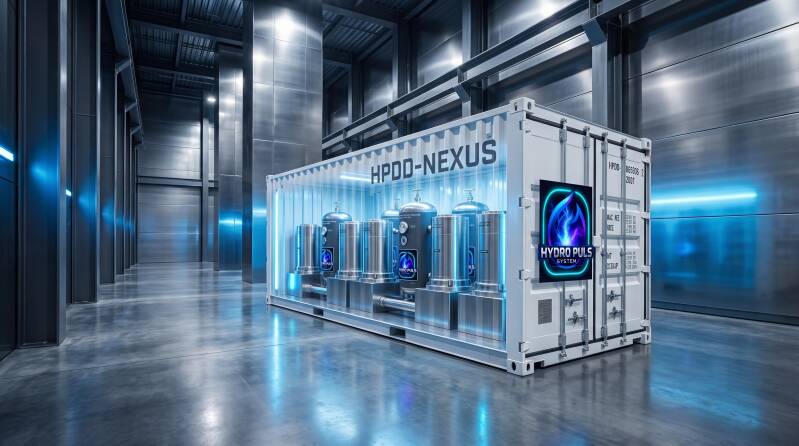
HPDD Nexus (Steam turbine replacement)
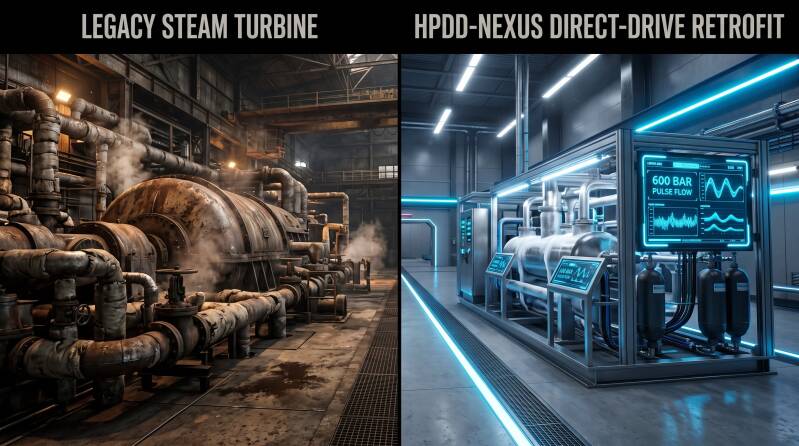
The HPDD Nexus: The Ultimate Thermodynamic Paradigm Shift
The traditional steam turbine has served the industrial world for over a century. However, in today's modern energy landscape, defined by grid congestion, extreme efficiency demands, and the urgent need for operational flexibility, legacy turbines are hitting their physical limits. Large, monolithic systems lose massive efficiency under part-load conditions, cause severe capital destruction during downtime, and require complex, site-locked civil infrastructure.
The Hydro Puls Direct-Drive (HPDD) Nexus shatters this status quo. The HPDD Nexus is not a traditional rotating turbine; it is an autonomous, streamlined closed-loop power system characterized by the absolute omission of legacy auxiliary processing units. It utilizes no physical separation vessels, no internal fuel feed systems, and no Nitrogen gas storage or injection lines within the working fluid loop. Instead, it is a massively parallel, decentralized matrix engineered to convert extreme pressures and thermal cascades into stable, maximum power with unprecedented reliability.
The Technology: How the HPDD Nexus Rewrites the Rules
The HPDD Nexus introduces a modular linear fluidic matrix platform that eliminates the inherent vulnerabilities of traditional systems by completely decoupling mechanical processes:
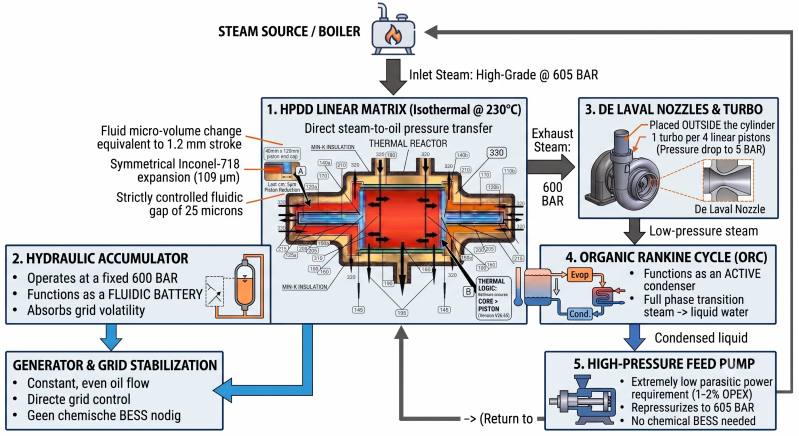
- Extreme Pressure Management (+600 bar): High-grade steam enters the cylinders at a nominal absolute pressure of 605 bar. Instead of letting this brute force smash directly onto fragile, rotating turbine blades, our opposed-piston architecture (2 pairs of pistons arranged in absolute opposition) absorbs the kinetic impact through a micro-stroke of exactly 1.2 mm. The siloxane thermal medium surrounding this core remains strictly not under pressure.
- Isothermal Symmetry at 230°C: Thanks to advanced metallurgical synchronization, both identical Inconel-718 component parts, the cylinder boring and the linear piston, undergo a symmetrical thermal expansion of exactly 109 µm at the standard operating temperature of 230°C. This ensures that the critical operational fluidic gap of 25 microns remains perfectly intact under all conditions, without binding or blowout.
- Optimized Ratios: The mechanical foundation relies on a strictly defined 120/40 piston ratio, a precise piston diameter-to-bellows ratio of 1/16, and a mathematically optimized spiral sealing angle configuration to control fluid boundary layers under high-pressure dynamics.
- The Fluidic Battery (Hydraulic Accumulator): While traditional turbines are mechanically bound directly to a generator via a rigid shaft, HPDD completely decouples this process. Steam energy creates linear hydraulic pressure, which is instantly routed to a high-pressure hydraulic accumulator at 600 bar. This functions as a fluidic battery, feeding the downstream generator with a continuous, perfectly equalized flow of hydraulic oil for extreme, unprecedented precision control. Any fluctuations in steam supply are seamlessly mitigated by the accumulator and an upstream steam buffer vessel.
The Thermal Cascade: The ORC as an Active Condenser
In the HPDD Nexus configuration, the primary, extreme pressure reduction is entirely shifted outside the cylinder. The fluid expands through specially profiled, convergent-divergent DeLaval nozzles directly upstream of the turbochargers (exactly 1 dedicated turbocharger per 4 linear pistons). The steam exits this configuration at approximately 5 bar and is routed directly into the primary heat exchanger of an Organic Rankine Cycle (ORC).
This is where the thermodynamic optimization happens:
-
Auxiliary Power Harvesting: The integrated ORC loop extracts latent thermal gradients and phase-change heat from the low-grade steam to drive secondary electricity generation.
-
Low-Energy Repressurization: The ORC functions strictly as the system's primary condenser. By forcing the 5 bar steam to undergo a complete phase transition entirely back into liquid water, a high-pressure feed pump can mechanically repressurize the fluid back to the initial 605 bar baseline effortlessly, with minimal parasitic power consumption before it re-enters the thermal loop.
De Business Case for the Operator: Why HPDD Nexus Wins
- 99.999% Modular Uptime: When a traditional megaturbine blocks or experiences a "trip", the entire power plant immediately halts, a critical, potentially catastrophic challenge in nuclear environments. Because the HPDD matrix utilizes a massively parallel, decentralized array, it inherently achieves a fault-tolerance that smoothly bypasses individual module faults without inducing system-wide thermal shock.
- Operational Duality (Peak-Shaving & Load-Balancing): The HPDD Nexus can be installed in parallel as a dynamic stabilization matrix integrated with conventional monolithic power systems (e.g., legacy 100MW steam turbines). While the logge turbine is maintained at a constant, highly optimized baseline output, the parallel HPDD Nexus modules absorb all grid and process fluctuations. The array can dynamically modulate its output seamlessly across a wide operating envelope (e.g., from 2MW up to 20MW combined) with zero efficiency degradation or thermal stress to the primary power loop, optimizing the operational life (OPEX) and fuel efficiency of the entire multi-megawatt site.
- Future-Proof Scalability: The HPDD platform grows fluidly alongside compounding industrial and hyperscale demands. With a defined future scalability target of 200 Hz / 600 kW continuous operational capability, the platform proves its fluid growth capacity for heavy infrastructure.
One Core Engine. Infinite Industrial Applications.
Whether deployed as a standalone closed-loop power generator or functioning as an ultra-fast, zero-loss "peak-shaving" stabilization shell around legacy megaturbines, the HPDD Nexus adapts seamlessly to the realities of modern energy demand. Engineered from the ground up to minimize asset risks and maximize financial and thermal performance.