

Zero Liquid Discharge (ZLD)
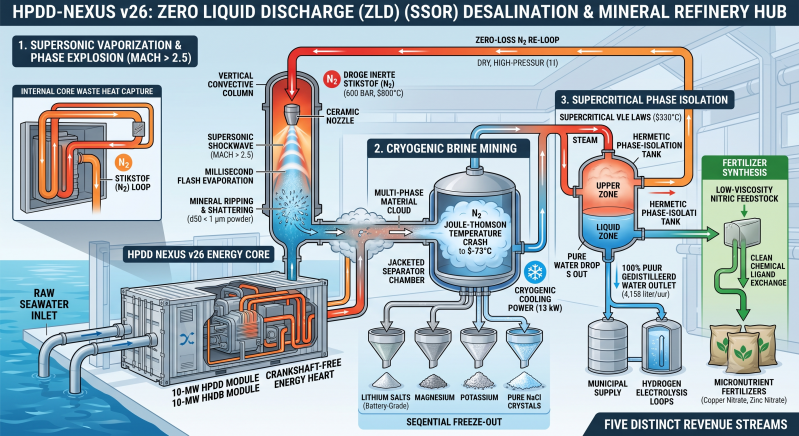
HPDD-NEXUS v26: Zero Liquid Discharge (ZLD) Desalination & Mineral Refinery Hub
The Future of Water Sovereignty: Zero Membranes, Zero Toxic Brine, Pure Value.
Across global networks, traditional methods for large-scale seawater desalination are hitting an unsustainable economic and environmental wall. The HPDD v26 architecture completely shifts this paradigm. By upgrading the primary utility block to an autonomous, software-defined, crankshaft-free energy core, we bypass electrical conversion losses entirely.
Instead of treating hyper-saline brine as an environmental liability, the platform transforms it into a highly profitable, zero-emission resource refinery natively at the machine face.
- Operational Threshold: Continuous 24-hour mass-balance stability () under strict Six Sigma control.
- Commercial Model: Distributed Infrastructure leasing under an Energy-as-a-Service (EaaS) framework.
The Core Problem: The Reverse Osmosis Carbon & Brine Tax
Traditional seawater desalination networks utilizing Reverse Osmosis (RO) membranes or thermal Multi-Stage Flash (MSF) distillation blocks accept severe macroeconomic liabilities:
-
The Grid Dependency Choke: Pumping seawater through dense membrane pores demands immense, continuous electrical grid connections, exposing utility providers to volatile tariff structures and high parasitic energy taxes.
-
The Hyper-Saline Liability: Every liter of pure water produced generates an equivalent volume of dense, toxic hyper-saline waste brine. Dumping this byproduct back into the marine ecosystem triggers crushing environmental penalties and severe structural scaling inside coastal utility lines.
-
he Membrane Replacement Burn: High mechanical pressures induce rapid particulate accumulation and biological fouling, forcing frequent, expensive plant shutdowns for aggressive acid washings that degrade infrastructure life cycles.
The Disruption: A 3-Step Microfluidic Transport Sequence
The HPDD-NEXUS v26 architecture eliminates conversion losses and handles massive material separation natively at the machine face through a precise three-step sequence:
Raw seawater is fed directly into sealed vertical convective columns. The system siphons an oxygen-free, bone-dry inert Nitrogen gas loop compressed to 600 BAR and superheated to by capturing internal core waste heat.
This energized, multi-phase material cloud moves straight into a jacketed separation chamber. As the high-pressure Nitrogen gas cloud expands into the 1 BAR chamber, it undergoes an automated, catastrophic Joule-Thomson temperature crash down to . This delivers 13 kW of pure cryogenic cooling power per 10-MW module without a single moving refrigerator part.
The remaining superheated steam and mineral-heavy liquid track enter a hermetic phase-isolation tank operating under Supercritical Vapor-Liquid Equilibrium (VLE) laws at . Exploiting the vast density gap at this exact supercritical threshold, 100% pure, mineral-free, unpolluted distilled water drops out cleanly at the bottom (4,158 liters/hour per module) to re-feed municipal pipelines or hydrogen electrolysis loops.
The containerized 10-MW HPDD Desalination module completely eliminates environmental liabilities and water overhead, turning seawater directly into five distinct, bankable revenue streams:
- Ultra-Pure Technical-Grade Distilled Water: Zero scale, zero membrane fouling; perfect for municipal supply or green hydrogen production.
- Battery-Grade Lithium & Magnesium Crystals: Sovereign strategic energy storage assets for the global transition.
- High-Purity Industrial and Food-Grade Salts: Pure, high-yield crystals commercially ready for global market origination.
- Copper and Zinc Crystalline Micronutrient Fertilizers: Asset-backed agricultural commodities generated directly from treated minerals.
- Zero Liquid Discharge (ZLD) Compliance Certificate: Total elimination of environmental penalties, discharge levies, and ecological liabilities.
Within our technological roadmap, the HPDD-NEXUS v26 has advanced far beyond the conceptual stage. The complete thermodynamic matrix and fluid transport kinetics have been fully validated using our advanced, aerospace-grade digital twin software. We are currently actively evolving from TRL 5 to TRL 6, with our first full-scale physical deployment prototype actively in fabrication under the guidance of a world-class team of prominent scientists and engineers.
