

What if coastal data centers and communities didn’t deplete local freshwater supplies,but brought millions of gallons of new freshwater ashore from beneath the seabed? 🌊💧
That is the visionary premise behind the Water Camel Project (developed by William B. Hawley under the Water Sustainability and Solutions Program): using autonomous variable-buoyancy subsea collectors to capture natural What if co discharges at deep-seabed springs before they mix with seawater, transporting up to 3.7 million gallons per cycle via sea-recovery vessels to coastal hubs.
A bold infrastructure concept like this deserves an equally integrated energy and water architecture. Here is how Hydro Puls Direct-Drive (HPDD) + VCD can help turn the Water Camel vision into a bankable, zero-emission reality:
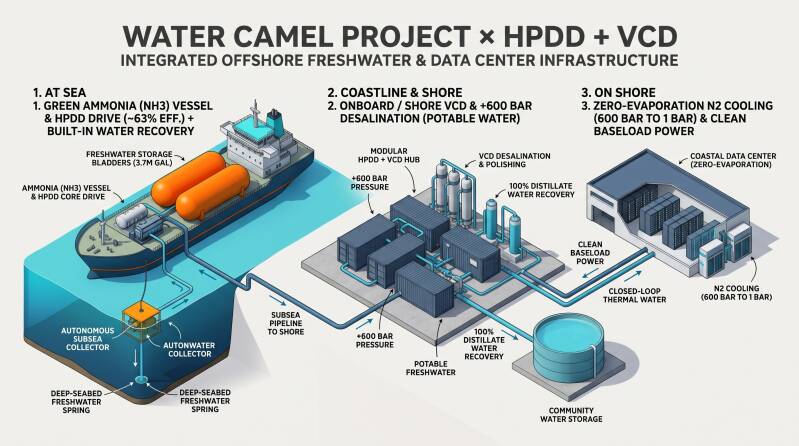
1️⃣ Green Ammonia Propulsion & Machinery with Built-In Water Recovery:
Powering the sea-recovery vessel, subsea offload pumps, and shore hub machinery on 100% green ammonia (NH₃) via opposed rodless free-piston HPDD cores (~63% net efficiency). Better yet: oxidizing hydrogen-rich ammonia inside a closed condensation loop generates pure reaction water as a byproduct,adding extra freshwater on every voyage.
2️⃣ Onboard & Shore-Hub Desalination / Brackish Polishing (VCD + 600 bar):
Subsea freshwater plumes naturally experience partial mixing at the seawater interface. By integrating direct +600 bar hydraulic RO pumping alongside 1-bar VCD thermal distillation (driven by HPDD’s 230 °C waste heat), the vessel or coastal hub can polish brackish inflows into guaranteed potable and ultrapure water.
3️⃣ Zero-Evaporation Data Center Cooling & Clean Baseload Power at the Shore Hub:
Bringing water ashore only solves half the equation if coastal data centers evaporate it right back into the atmosphere. At the shore hub, HPDD’s closed-loop 600-bar N₂ expansion provides chiller-free, zero-evaporation cooling alongside clean baseload power,preserving Water Camel’s freshwater for municipal and industrial communities.
When visionary maritime water harvesting meets closed-loop thermodynamic engineering, coastal infrastructure becomes truly water- and energy-positive.
Shout-out to William B. Hawley and