

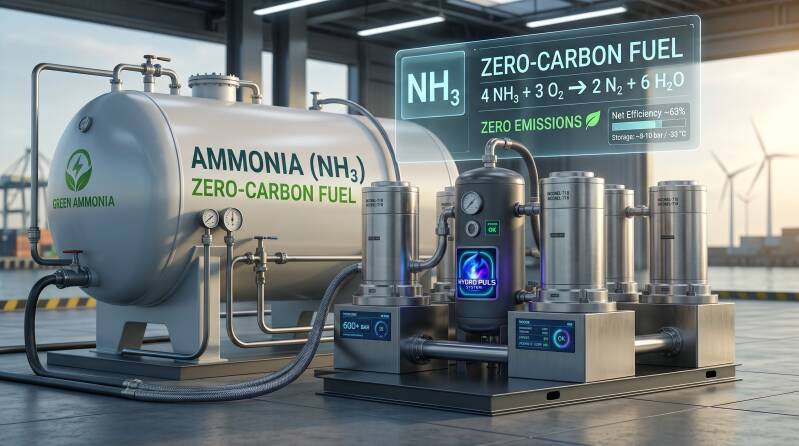
Ammonia as a Zero-Carbon Fuel: Straight Answers to the 8 Most Common Questions 🔍⚡
Whenever we share that Hydro Puls Direct-Drive (HPDD) runs on carbon-free green ammonia (NH3), the same practical questions come up right away. Here are the engineering and commercial facts:
1. Is ammonia actually available?
Yes, ammonia is one of the most widely produced chemicals on Earth, at over 180 million tons per year, supported by decades-old global terminals, ocean tankers, pipelines, and storage networks.
2. Where can you buy it?
Low-carbon and green ammonia is produced in solar- and wind-rich hubs across the Middle East, North Africa, Australia, the Americas, and Northern Europe, and is traded and delivered through major industrial ports like Rotterdam and Antwerp by established energy and industrial gas suppliers.
3. How do you store it?
Far more easily than hydrogen. While liquid hydrogen requires -253 °C or 700 bar pressure, ammonia liquefies at ambient temperature under a moderate pressure of roughly 8 to 10 bar, similar to propane or LPG, or at -33 °C at atmospheric pressure, packing nearly twice the volumetric energy density of liquid hydrogen.
4. Is it expensive?
Because ammonia avoids costly cryogenic cooling and ultra-high-pressure tanks, shipping and storage costs are a fraction of hydrogen's. Paired with HPDD's ~63% net electrical efficiency (>85% total energy utilization), the delivered cost per kWh is highly competitive.
5. Is it dangerous?
Ammonia is toxic and has an unmistakable pungent odor that makes even tiny leaks immediately detectable. Heavy industry has safely handled ammonia for over a century using double-walled piping, automated sensors, and sealed containment protocols.
6. Can it explode?
Its explosion risk is remarkably low. Ammonia has a narrow flammability range (15% to 28% in air) and a high autoignition temperature (651 °C), making it far harder to ignite or detonate than natural gas, hydrogen, or gasoline vapor.
7. Does it even burn well?
In a conventional crankshaft engine, ammonia burns slowly and poorly, requiring diesel pilot fuel. That is precisely why we engineered HPDD: using recuperative in-situ catalytic hydrogen enrichment powered by internal waste heat (< 374 °C) inside a decoupled two-circuit pulse core, the reaction (4 NH3 + 3 O2 → 2 N2 + 6 H2O) runs cleanly without pilot fuel and with zero exhaust plume.
8. Doesn't it take a lot of energy to produce?
Synthesizing green ammonia from green hydrogen adds a conversion step, yet it saves far more energy and capital across global transport and storage, and when converted on-site at ~63% net electrical efficiency alongside distilled water (~0.42 L/kWh) and dry nitrogen, the full well-to-power economics work decisively in its favor.
Ammonia is not a laboratory curiosity, it is a global, scalable zero-carbon energy carrier waiting for the right conversion architecture.
#Ammonia #CleanTech #EnergyTransition #ZeroEmissions #Hydrogen #DataCenters #GreenShipping #HPDD