

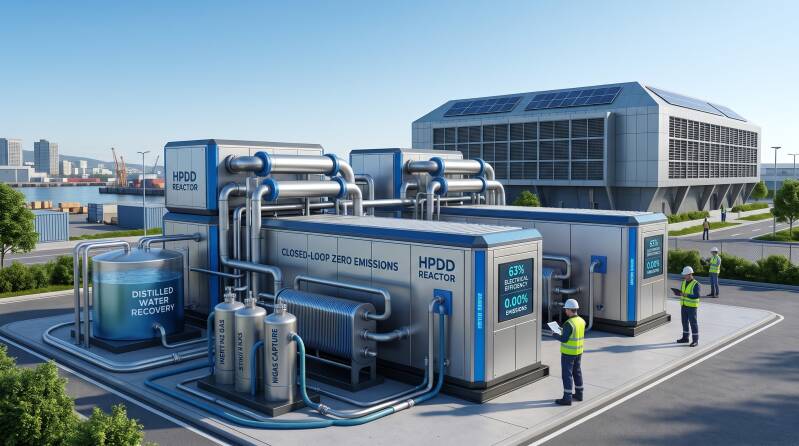
Is the complete absence of emissions, not even having an exhaust stack on HPDD reactors, a true gamechanger? 🏭🚫💨
Most clean-energy discussions still revolve around "emissions reduction" and expensive exhaust aftertreatment, yet the real breakthrough happens when you eliminate the exhaust pipe altogether.
On Hydro Puls Direct-Drive (HPDD) reactors, there is no atmospheric exhaust stack at all, and that reshapes permitting, site selection, and plant economics in four decisive ways:
1. Zero Exhaust Plume, Zero Local Air Pollution (0 CO2, 0 NOx, 0 Particulates)
Our reaction core converts carbon-free green ammonia and ambient air strictly into nitrogen and water vapor (4 NH3 + 3 O2 → 2 N2 + 6 H2O). Active temperature moderation prevents thermal NOx formation, resulting in zero CO2, zero SOx, and zero particulate emissions.
2. Internal Condensation Instead of Venting Energy Up a Stack
Conventional engines and turbines lose massive amounts of heat and water vapor through their exhaust funnels. HPDD condenses reaction steam internally within a closed architecture, supporting ~63% net electrical efficiency and >85% combined heat and power utilization.
3. Turning Exhaust Vapor into Two Valuable On-Site Utilities
Because nothing is vented into the sky, the system captures two high-value streams on-site: mineral-free, distilled-grade water (~0.42 L/kWh, yielding ~126 L/hr per 300 kW module or ~100 m³/day per 10 MW) and dry, inert nitrogen gas (N2) for fire suppression or industrial blanketing.
4. Faster Permitting Close to Cities, Ports, and Data Centers
With zero smokestack, zero nitrogen deposition, and zero cooling towers, the primary environmental permitting roadblocks disappear, whether deploying behind the meter at an AI data center, inside an industrial plant, or onboard an ocean vessel.
True zero-emission engineering isn't about bolting filters onto an exhaust pipe, it is designing a core where nothing needs to be vented in the first place.
#ZeroEmissions #CleanTech #EnergyTransition #DataCenters #GreenShipping #Ammonia #Engineering #HPDD