

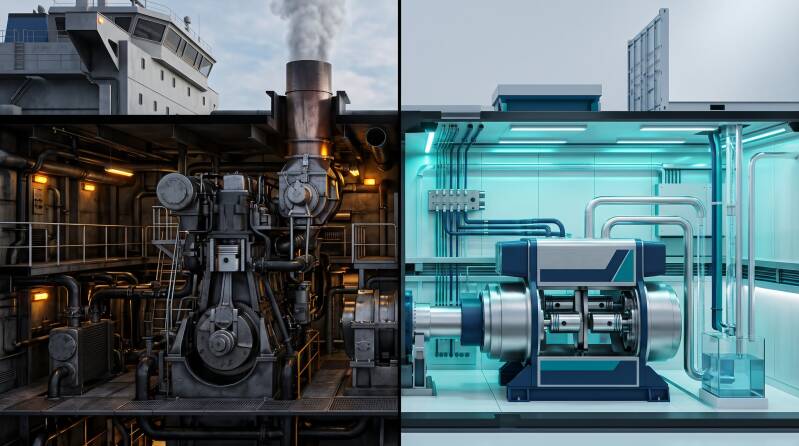
Ammonia in a Conventional Marine ICE vs. Hydro Puls Direct-Drive (HPDD): What Actually Changes Onboard? ⚓⚙️
Many shipowners are evaluating green ammonia (NH3) to decarbonize deep-sea shipping. Yet injecting ammonia into a conventional crankshaft internal combustion engine (ICE) forces major compromises in efficiency, emissions control, and machinery complexity.
Here is how a vessel powered by a conventional NH3-ICE compares to one powered by Hydro Puls Direct-Drive (HPDD):
1. Load-Chasing Combustion vs. Decoupled Pulse Core
• Conventional Marine ICE: The engine must continuously follow propeller and maneuvering transients. Because ammonia has a low flame speed and narrow flammability window, part-load operation often requires carbon-based pilot fuels and risks ammonia slip, thermal NOx, and N2O (nearly 300x the warming impact of CO2).
• HPDD: Our two-circuit pulse architecture decouples energy conversion from dynamic drivetrain loads. The zero-carbon reaction (4 NH3 + 3 O2 → 2 N2 + 6 H2O) operates continuously in a controlled thermal sweet spot, assisted by recuperative in-situ catalytic enrichment using internal waste heat (< 374 °C), while a +600 bar hydrostatic drive handles variable propulsion power.
2. Machinery Room & Mechanical Complexity
• Conventional Marine ICE: Heavy crankshafts, connecting rods, reduction gearboxes, large lube-oil systems, high mechanical friction, and structural vibration.
• HPDD: 4 pairs of horizontally opposed free pistons (8 pistons total) with self-canceling inertia, eliminating crankshafts, lubricating engine oil, and vibration. Matched Inconel cylinder bores and pistons expand identically (109 µm at 230 °C) to maintain a constant 25 µm radial clearance.
3. Efficiency, Cooling & Stack Emissions
• Conventional Marine ICE: ~45%–50% shaft efficiency, heavy seawater cooling loads, and a hot exhaust stack requiring complex SCR aftertreatment.
• HPDD: ~63% net electrical efficiency (>85% combined heat & power), zero external cooling towers via an unpressurized 230 °C closed-loop siloxane thermal circuit, and zero atmospheric exhaust plume (0 CO2, 0 NOx, 0 SOx).
4. Onboard Utilities: Fresh Water & Inert Nitrogen
• Conventional Marine ICE: Vents water vapor up the stack and relies on separate freshwater makers and inert-gas generators.
• HPDD: Internal condensation and gas separation co-produce ~0.42 L/kWh of distilled-grade water (~126 L/hr per 300 kW module; ~4,160 L/hr or ~100 m³/day per 10 MW) plus dry, inert nitrogen (N2) for tank blanketing and fire suppression.
Winning in ammonia-powered shipping is not about retrofitting legacy diesel mechanics, it is about engineering the propulsion core around ammonia’s true thermodynamics.
#MaritimeDecarbonization #GreenShipping #AmmoniaFuel #MarineEngineering #CleanTech #ZeroEmissions #Propulsion #HPDD