

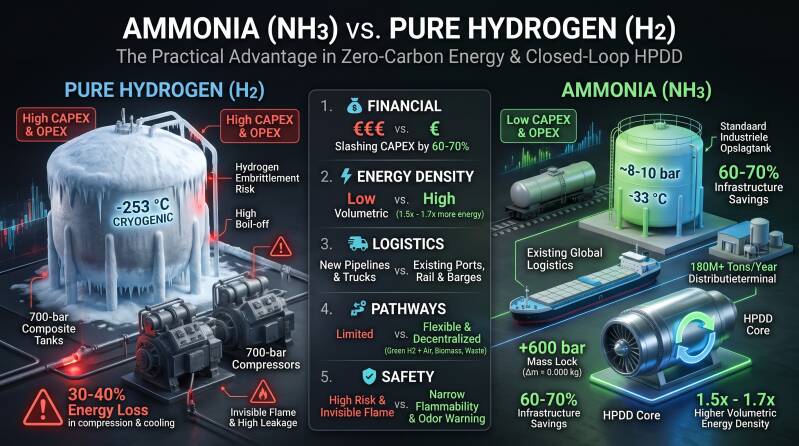
Why Ammonia (NH3) Beats Pure Hydrogen (H2) on Every Practical Industrial Metric ⚡💧
Hydrogen gets the headlines, but when you look at real-world industrial economics, infrastructure, and safety, Ammonia (NH3) is the far superior zero-carbon energy carrier, especially inside a hermetically sealed, closed-loop engine like Hydro Puls Direct-Drive (HPDD).
Here is why NH3 outperforms pure H2 across all five critical dimensions:
1. Financial (CAPEX & OPEX Advantage)
• Pure H2 requires ultra-expensive 700-bar composite tanks, cryogenic liquefaction (-253 °C), or new dedicated pipelines, burning up to 30%–40% of its own energy just in compression and cooling.
• NH3 liquefies easily at ambient temperature (~8–10 bar) or -33 °C, slashing storage, transport, and infrastructure CAPEX by more than 60%–70% per MWh stored.
2. Technical & Energy Density
• Liquid NH3 packs ~1.5x to 1.7x more volumetric hydrogen energy density than liquid H2, and over 2.5x more than 700-bar compressed H2, without cryogenic boil-off losses or hydrogen embrittlement of standard steel piping.
• Inside our +600 bar opposed free-piston HPDD core (~63% net electrical efficiency, 230 °C closed-loop siloxane thermal circuit), NH3 delivers high-density, zero-exhaust thermodynamic power with zero NOx and zero CO2.
3. Global Availability & Existing Logistics
• Over 180–200 million tons of ammonia are already produced, shipped, and stored globally every year through mature ports, rail cars, barges, and agricultural terminals. No multi-decade wait for a "hydrogen backbone."
4. Multi-Production Pathways (Flexible & Decentralized)
• Unlike pure H2, which relies almost exclusively on capital-heavy PEM/alkaline electrolyzers or steam methane reforming, NH3 can be synthesized locally from multiple sources: green hydrogen + ambient nitrogen (78% of air), biomass/biogas, hydrothermal gasification, or non-condensable off-gases from waste tyre and plastic upgrading.
5. Safety & Hermetic Mass Lock (Δm = 0.000 kg)
• Pure H2 has an invisible flame, an ultra-wide explosive range (4%–75% in air), tiny ignition energy, and high diffusivity through seals.
• NH3 has a narrow flammability window (15%–28%), high ignition temperature (651 °C), and an immediate natural odor warning at 5 ppm, well below harmful levels. Better yet, inside our hermetically sealed HPDD core with its 25-micron gas-curtain seal (Δm = 0.000 kg), NH3 stays 100% locked inside a closed loop with zero exhaust stack.
Don't fight physics with cryogenic hydrogen. Deploy closed-loop ammonia power where infrastructure already exists.
#Ammonia #Hydrogen #EnergyTransition #CleanTech #ZeroEmissions #Microgrids #GreenAmmonia #HPDD