Why are we still forcing wet biomass through mechanical extrusion dies?
Heavy industry urgently needs renewable carbon vectors to displace pulverized coal and heavy fuel oil. Yet the global default, wood pellets, carries an unsustainable thermodynamic penalty:
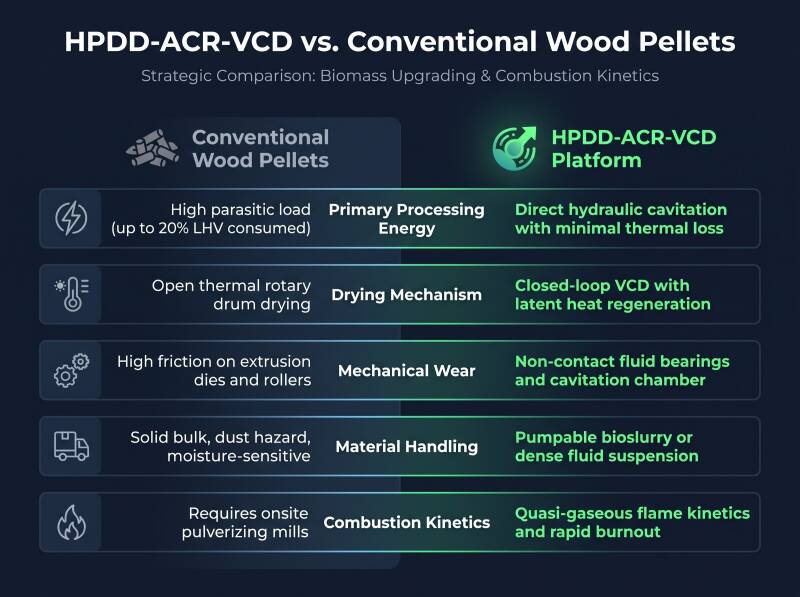
• Up to 20% Net Energy Penalty: Evaporative rotary dryers and mechanical die friction consume a major portion of the raw feedstock's lower heating value (LHV).
• Severe Mechanical Wear: High-pressure dies, rollers, and feed screws require constant maintenance and downtime.
• Logistical Bottlenecks: Solid pellets degrade in moisture, carry severe dust explosion risks, and still require energy-intensive onsite pulverizing mills before injection into an industrial flame.
The solution is not building bigger pellet mills. It is rethinking biomass upgrading through fluid dynamics.
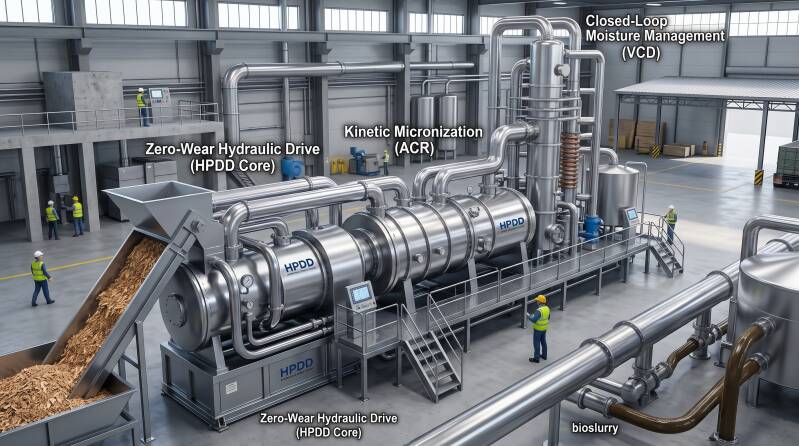
Introducing the HPDD-ACR-VCD platform: converting raw sawdust and fibrous residues into high-calorific, pumpable bioslurry via kinetic cavitation and closed-loop thermal harvesting.
How the architecture works:
1. Zero-Wear Hydraulic Drive (HPDD Core):
Powered by our crankshaft-free Hydro Puls Direct-Drive operating on a closed ammonia thermodynamic cycle. Pressurized water film bearings eliminate metal-to-metal contact, piston rings, and lubricating oil, delivering continuous hydraulic working pressures up to +600 bar.
2. Kinetic Micronization (Acoustic Cavitation Reactor - ACR):
Under extreme hydraulic pressure, biomass slurry enters the ACR. Imploding cavitation bubbles unleash micro-jets (>1,000 m/s) and severe shear forces, disintegrating recalcitrant lignocellulosic bonds at the cellular level. Wood fibers are defibrillated within milliseconds into a sub-micron, homogeneous suspension.
3. Closed-Loop Moisture Recovery (Vapor Compression Distillation - VCD):
Instead of venting latent heat into the atmosphere, the integrated VCD column recovers water via mechanical vapor compression. Recycling 100% of latent vaporization heat slashes dewatering energy by over 70% compared to conventional thermal drying.
Direct industrial applications:
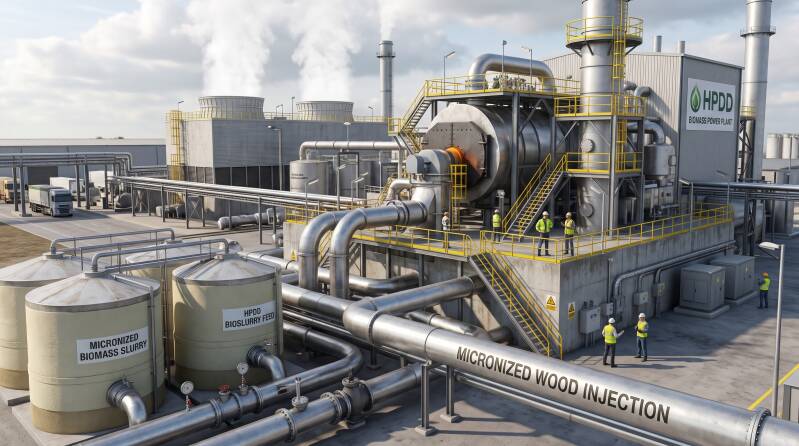
• Cement & Lime Kilns: Direct slurry/pneumatic injection into calcination zones, replacing pulverized coal with near-zero unburned carbon.
• Decentralized Bioslurries: Blending micronized wood particles into pyrolysis oil or bio-carriers to produce pumpable, zero-sulfur marine and boiler fuels.
• Biochemicals & Gasification: Feedstock preparation for rapid enzymatic hydrolysis (cellulosic ethanol) or tar-free entrained-flow gasification.
Stop treating biomass processing as a dry mechanical grinding problem. Fluid physics unlocks complete feedstock utilization.
#CleanTech #Biomass #Decarbonization #Bioenergy #HPDD #ProcessEngineering #HeavyIndustry #CircularEconomy