

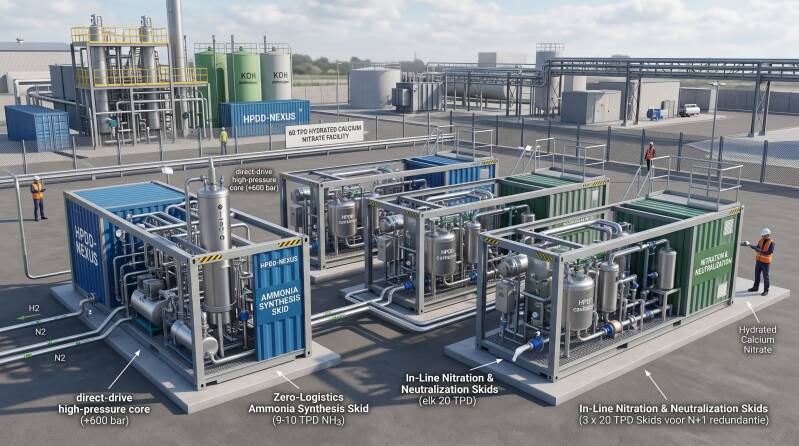
Decentralized Chemical Synthesis: Why Transport Ammonia When You Can Synthesize and Convert It In-Line?
Traditional fertilizer and chemical manufacturing relies on massive centralized plants. This model forces operators to transport pressurized, hazardous anhydrous ammonia (NH3) across public road and rail infrastructure, incurring severe regulatory constraints, safety risks, and surging logistics costs.
Here is how a modular, skid-mounted architecture completely rewrites that playbook for a 60 TPD Hydrated Calcium Nitrate facility:
The Challenge:
A client with access to industrial feedstocks (electrolytic hydrogen from a caustic potash plant and biogenic methane) needed 60 TPD of hydrated calcium nitrate without incurring the CAPEX, permitting delays, and hazardous logistics of conventional merchant ammonia plants.
The Solution: Direct-Coupled HPDD-NEXUS Architecture
Instead of building a monolithic chemical plant or trucking in ammonia, we deploy a closed-loop, modular train:
1. Zero-Logistics Ammonia Synthesis Skid (9–10 TPD NH3):
By utilizing pure surplus H2 from KOH electrolysis (or thermal reforming of biogenic methane) and combining it with isolated N2 via our direct-drive high-pressure core (+600 bar), ammonia is produced natively on-site. Exactly to the stoichiometric demand needed (~8.65 TPD NH3 for 60 TPD hydrated product).
2. In-Line Nitration & Neutralization (3 x 20 TPD Skids):
The synthesized ammonia is directly fed into the HPDD cavitation reactor alongside Calcium Hydroxide [Ca(OH)2]. The reaction occurs immediately in-line:
• No hazardous ammonia storage tanks.
• No merchant nitric acid handling.
• Exothermic reaction heat is internally harvested to drive process concentration.
3. Standardized Plug-and-Play Modularity:
Rather than a single 60 TPD bespoke plant, deploying 3 x 20 TPD containerized units delivers N+1 industrial redundancy. Scheduled maintenance on one unit leaves 67% of production running, while drastically reducing civil works and on-site assembly time.
The takeaway for heavy industry:
Decarbonization and chemical production are moving away from centralized giants toward agile, containerized, behind-the-meter industrial hubs.
Stop shipping hazardous molecules. Synthesize, react, and valorize them right where they are needed.
#ChemicalEngineering #ProcessEngineering #Decarbonization #Ammonia #Fertilizers #HPDD #NEXUS #ModularDesign #CleanTech #HydrogenEconomy