

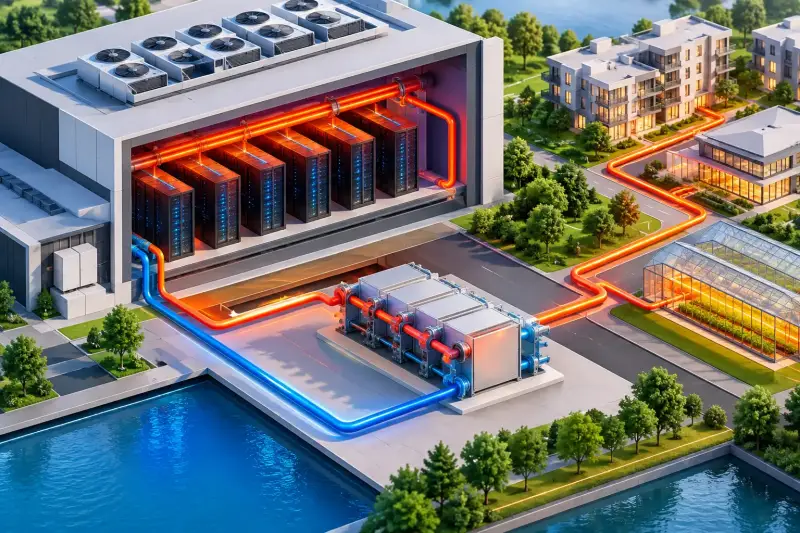
Data Center Heat Reuse Trends Reshaping Design
November 7, 2026A 30 MW data center can reject enough low-grade heat to become a local energy asset, yet most facilities still treat that thermal output as a disposal problem. Data center heat reuse trends are changing that calculation. Rising rack densities, AI workloads, constrained grid capacity, and stricter carbon accounting are forcing developers to evaluate the facility as an integrated power, cooling, water, and heat system rather than a building full of servers.
The opportunity is real, but it is not automatic. Recoverable heat has a temperature, a timing profile, a distance to demand, and a cost to upgrade. Projects succeed when those variables are engineered into the campus architecture from the start.
Data Center Heat Reuse Trends Moving Beyond Token Recovery
The first trend is a move from air-side heat recovery to liquid-centric thermal design. Conventional air-cooled halls often discharge heat near 86-104 F, which is useful for preheating ventilation air or domestic hot water but rarely sufficient for a large external heat customer without a heat pump. Direct-to-chip liquid cooling, rear-door heat exchangers, and immersion approaches can return water at materially higher temperatures. That improves the economics of recovery because every degree of temperature lift avoided reduces compressor work or broadens the number of usable sinks.
This does not mean every AI deployment should default to immersion cooling. Serviceability, hardware compatibility, leak management, water chemistry, and operator experience remain material constraints. But high-density compute is making warm-water loops increasingly relevant. The design question is no longer simply how to remove heat from silicon. It is whether the cooling loop can deliver heat at a grade another process can accept.
A second trend is the shift from annualized sustainability claims to hourly energy matching. A data center may have enough recovered heat on a yearly basis to supply a neighboring network, while still producing the wrong output during peak heating demand. Compute load can be steady, but district demand is seasonal. Thermal storage is therefore becoming a core asset, not a decorative add-on. Short-duration hot-water storage can absorb load swings, while larger seasonal systems may be justified where a dense district network, industrial campus, or greenhouse complex creates dependable demand.
The third trend is co-location. Heat is expensive to move because pipes, trenching, pumping, permissions, and heat losses all accumulate with distance. The strongest projects place a data center beside a heat-intensive process: greenhouse horticulture, food production, municipal water treatment, low-temperature drying, manufacturing wash processes, or a district energy network with existing distribution infrastructure. A modest heat source near a consistent customer can be more valuable than a larger source stranded several miles away.
Temperature Is the Commercial Boundary
Heat reuse discussions often fail because they quote megawatts without defining temperature. Thermal power alone is not the product. A 10 MW heat stream at 95 F and a 10 MW stream at 167 F have very different industrial value.
Low-temperature heat can serve slab heating, preheat make-up water, aquaculture, and selected greenhouse loads. Mid-temperature heat can support district networks designed around lower supply temperatures, industrial cleaning, and many process-preheat duties. Higher-temperature requirements, including steam replacement, drying, and chemical production, generally demand a heat pump cascade, mechanical vapor recompression, combustion backup, or another upgrade path.
That upgrade is not necessarily a penalty. A heat pump can convert a low-grade stream into useful process heat with a coefficient of performance that is attractive compared with resistive heating or standalone fossil boilers. However, the business case depends on electricity price, heat-pump operating hours, refrigerant selection, source-side temperature, and the buyer's avoided fuel cost. The correct framing is not that recovered heat is free. It is that recovered heat can be a low-cost thermal input when the system boundary is designed correctly.
The Water Constraint Cannot Be Ignored
Water is becoming as strategic as power in large-scale data center development. Evaporative cooling may reduce electrical cooling demand, but it can introduce meaningful water consumption and local permitting pressure. Heat-reuse architecture must therefore be evaluated alongside the water balance.
Closed-loop liquid systems can reduce reliance on consumptive cooling, but they require disciplined treatment, filtration, monitoring, and redundancy. Where water production, recovery, or reuse is part of the campus strategy, thermal integration can provide further value. The objective is not merely lower PUE. It is a lower total resource intensity across electricity, water, refrigerants, backup generation, and heat rejection.
Why On-Site Energy Changes the Equation
Heat reuse is often modeled as an appendage to utility power: electricity enters, servers consume it, cooling rejects the resulting heat, and an external user takes what is available. That model overlooks the value of integrated energy conversion.
An on-site combined heat and power architecture can coordinate electrical generation, cooling duty, thermal delivery, and resilience. Instead of relying entirely on grid imports and separate emergency assets, the facility can be designed around dispatchable energy cores that operate near their most efficient point. The resulting thermal streams can be assigned to absorption cooling, heat pumps, process loads, water production, or external heat customers according to real-time value.
For operators, this is fundamentally a capacity and risk discussion. Grid interconnection delays can postpone a data center by years. Transmission constraints can limit expansion even after commissioning. A modular on-site architecture can reduce dependence on a single connection path while supplying multiple useful outputs. It also creates a clearer route to fuel transition, provided equipment is engineered for hydrogen, ammonia, or other future fuel pathways rather than merely advertised as adaptable.
Hydro Puls Systems positions its HPDD architecture as an Autonomous Energy Heart: a direct-drive system built around isolated combustion and hydraulic energy transfer, intended to decouple generation from variable load. For data center applications, the relevant proposition is not simply backup power. It is the ability to integrate hydraulic power, electrical generation, cooling, and water outputs into a common industrial energy platform.
Designing for a Real Heat Offtake
The heat customer should be defined before the mechanical design is frozen. Too many developments install a heat-recovery connection with no contracted offtake, no temperature guarantee, and no commercial owner for the interface. That produces an impressive schematic and an underused asset.
A bankable design starts with the receiver. What minimum supply temperature, return temperature, pressure, availability, and water quality does the customer require? Is the heat demand continuous or seasonal? Who owns the heat pump, thermal store, interconnecting pipe, and backup boiler? What happens when compute load falls, a cooling loop is isolated, or the customer needs more heat than the data center can provide?
Those questions define the redundancy strategy. The data center cannot compromise IT availability to meet a heat contract, and the heat customer cannot rely on a variable thermal source without backup. The practical answer is isolation between critical cooling and export loops, N+1 pumping and heat-exchange capacity where justified, thermal storage, and contract terms that recognize availability limits. Heat recovery is an energy product, but it must never become a new single point of failure for compute operations.
The Metrics That Matter More Than PUE
PUE remains useful, but it does not capture the value of recovered heat, avoided water use, or avoided fuel at the receiving site. Decision-makers should add metrics that reveal the full thermodynamic and financial picture: annual useful heat exported, heat-export availability, source and delivery temperatures, electrical input for temperature upgrading, water consumption intensity, carbon intensity by operating hour, and revenue or avoided-cost value per MWh of heat.
A facility with a slightly higher PUE may produce a stronger total outcome if it exports dependable heat that displaces gas-fired boilers or enables a critical industrial process. Conversely, a low-PUE site with no practical heat sink should not be burdened with costly infrastructure for a speculative future connection. The optimal design depends on local climate, rack density, power price, grid carbon profile, fuel availability, and the proximity of a creditworthy thermal buyer.
From Waste Heat to Thermal Infrastructure
The next generation of data centers will be judged less as isolated electrical loads and more as infrastructure nodes capable of producing digital capacity, useful heat, cooling, water, and grid-support value. That shift favors developers who model energy flows from first principles rather than optimizing each subsystem in isolation.
For a project team, the immediate step is simple: map the thermal resource at expected operating conditions, identify heat users within an economically viable radius, and test the integrated power-and-cooling architecture before land, utility, and equipment decisions become fixed. The most valuable heat-reuse projects are not added after the data center is designed. They are engineered into the campus from the first energy balance.