Why Renewable Power Gets Stranded at the Grid — and How HPDD Serves as the Missing Interface for Solar and Wind.
Solar farms and wind turbines generate gigawatt-hours of clean electrons, yet project developers and industrial operators face the same hard constraints:
1. Grid congestion and curtailment: surplus generation cannot enter overloaded transmission networks.
2. Intermittency: wind and solar supply power when weather permits, not when continuous 24/7 industrial processes require it.
3. Battery storage limits: electrochemical BESS excels at short-duration peak shaving (1 to 4 hours), but remains cost-prohibitive for continuous, heavy industrial duty and multi-day dispatch.
The core structural bottleneck stems from forcing every unit of renewable power through a single wire: the utility grid, layered with cascading transformers, inverters, and electric motor drives.
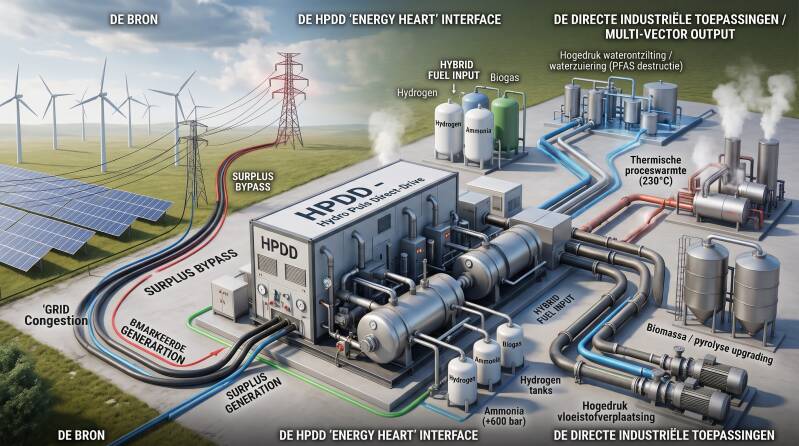
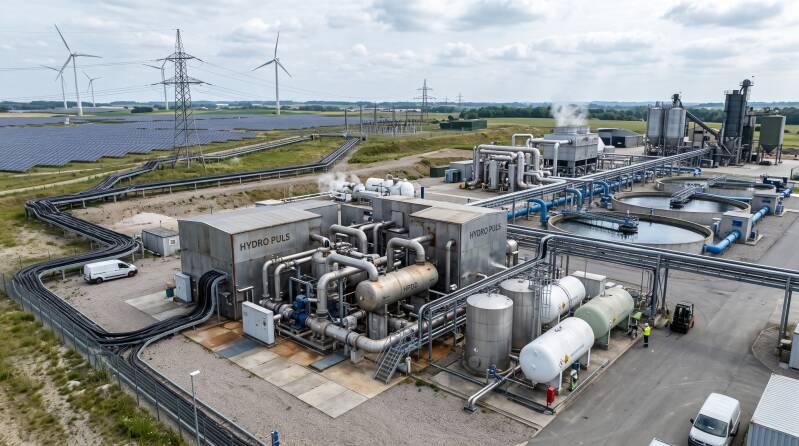
Hydro Puls Direct-Drive (HPDD) acts as a direct thermodynamic and mechanical interface behind the meter:
• Direct Conversion of Surplus Generation into Mechanical Work:
Instead of curtailing wind or solar output during grid congestion events, HPDD channels excess power directly into high-pressure and acoustic cavitation loops. This enables behind-the-meter water desalination, industrial wastewater treatment (PFAS destruction), and feedstock upgrading for biomass or plastic pyrolysis oil.
• Multi-Fuel Hybrid Firming Without Startup Penalties:
When solar irradiance drops or wind subsides, HPDD switches seamlessly to energy-dense dispatchable carriers such as hydrogen, ammonia, or biogas. Leveraging direct displacement and isolated combustion chambers, HPDD maintains continuous 24/7 process delivery independent of transmission queues.
• Multi-Vector Output:
Solar panels and wind turbines produce only electrical energy, whereas industrial sites require high-temperature process heat (230°C), thermal rejection, and high-pressure fluid displacement (+600 bar). HPDD converts inputs directly into mechanical, hydraulic, and thermal outputs, eliminating auxiliary electric steam boilers, high-tonnage chillers, and multi-stage gas compressors.
Renewable capacity does not need to wait for multi-year transmission reinforcements or substation queues. With HPDD acting as an autonomous on-site Energy Heart, variable renewable generation converts into continuous, dispatchable industrial capacity.
#HPDD #RenewableEnergy #SolarPower #WindEnergy #GridCongestion #Microgrids #ProcessEngineering #IndustrialAutarky #Decarbonization #CleanTech