

Why Raw Plastic Pyrolysis Oil Fails at the Refinery Gate, and How Cavitation Upgrades It Without a Cracker.
More and more plastic pyrolysis operators hit the same operational barrier:
You can run a continuous reactor processing mixed plastics (PE/PP), but tier-one refineries refuse your barrels or impose severe pricing discounts.
Even when bulk chlorides and heavy tars are filtered out locally, two fundamental processing hurdles stop refiners from using the oil for Sustainable Aviation Fuel (SAF):
1. The Carbon Distribution Is Too Broad:
SAF (ASTM D7566 / Jet-A1) demands a narrow kerosene boiling range: C9 to C16. Raw plastic pyrolysis oil is a chaotic mixture loaded with heavy, stubborn oligomers (C18 to C30+). Traditionally, cracking these requires high-CAPEX furnaces or hydrocracking infrastructure.
2. Aging and Gumming Inside Storage Tanks:
Raw pyrolysis oil contains highly reactive, conjugated diolefins. During storage and tanker transport, free radicals react and polymerize. The result: gums, sludge, and heavy sediments that foul downstream pumps, preheaters, and catalyst beds.
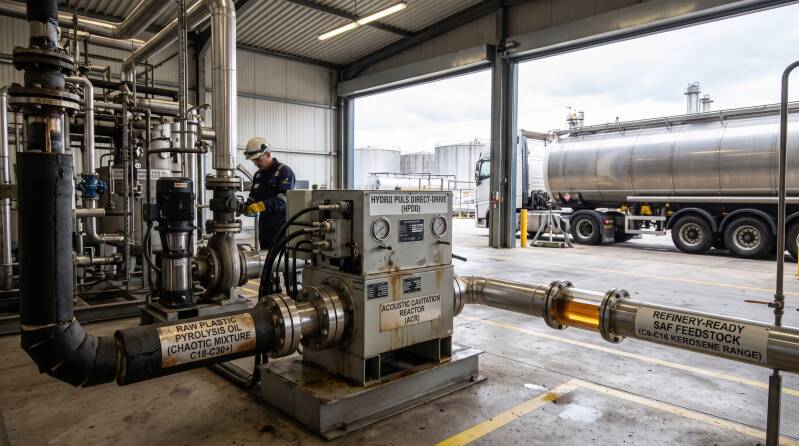
How Hydro Puls Direct-Drive (HPDD) combined with the Acoustic Cavitation Reactor (ACR) solves this between your storage tanks and the loading dock:
• Sonochemical Chain Scission (C-C Bond Shear):
HPDD drives the oil under 600-bar hydrodynamic pressure pulses into the ACR. Ultrasonic cavitation bubbles implode, generating localized micro-jets (>1,000 m/s) and extreme shear stress. This mechanical shear breaks heavy oligomer chains (C20+) down into the C9–C16 kerosene range, without requiring thermal cracking furnaces.
• Radical Termination & Storage Stability:
Nanoscale micromixing combined with synchronized 230°C thermal energy neutralizes radical precursors and halts chain polymerization. The oil remains homogeneous, low in viscosity, and sediment-free throughout transit.
• Direct Value at the Refinery:
By slashing kinematic viscosity and delivering a micro-homogenized fluid, you eliminate channeling and pressure drops across the refinery’s hydrotreating catalyst beds. This allows the refiner to run at higher throughput and lower severity, commanding a premium price per barrel.
The result: transforming problematic waste oil into stable, premium "refinery-ready" SAF feedstock directly from your tank farm.
#Pyrolysis #SAF #CircularPlastics #HPDD #ChemicalRecycling #Refining #ProcessEngineering #CleanTech #Decarbonization