

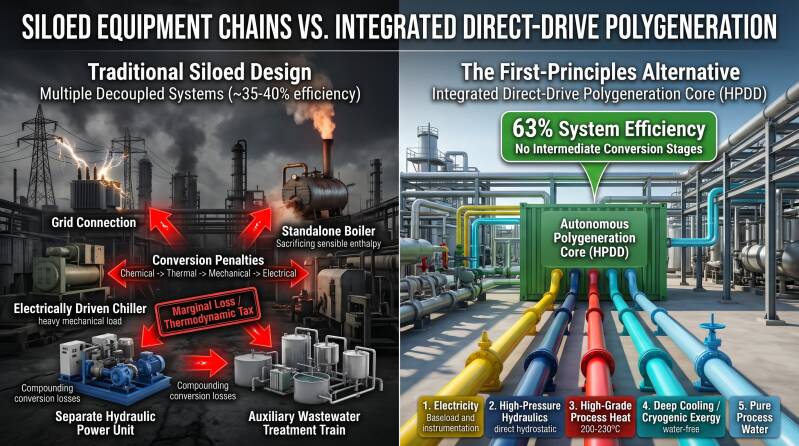
What makes more sense on an industrial site: 1 integrated core delivering 63% system efficiency, or 5 separate systems eroding your margins?
For decades, conventional plant design has relied on siloed thinking:
- A grid connection for electricity (vulnerable to transmission losses and peak demand tariffs)
- A standalone boiler for process heat (sacrificing sensible enthalpy through the stack)
- An electrically driven chiller (adding a heavy parasitic mechanical compressor load)
- A separate hydraulic power unit (compounding conversion penalties from generator to electric motor to pump)
- An auxiliary wastewater treatment train
The result? Compounding conversion penalties: Chemical \Thermal \ Mechanical \Electrical \Mechanical. At every step, you pay a steep thermodynamic tax. The cumulative lifecycle efficiency of these uncoupled chains often collapses well below 35–40%.
The First-Principles Alternative: Why decouple these energy streams when industrial facilities consume them simultaneously?
With the Hydro Puls Direct-Drive (HPDD) architecture, a single autonomous polygeneration core delivers:
- Electricity for baseload and site instrumentation
- High-pressure hydraulics directly via hydrostatic displacement (bypassing electric drive motors)
- High-grade process heat (200–230°C for drying, reactors, or thermal regeneration)
- Deep cooling / cryogenic exergy (completely water-free, eliminating peak chiller power)
- Pure process water
By capturing and redirecting energy vectors directly at the primary source without intermediate conversion stages, the integrated system achieves a combined efficiency of 63%.
For modern energy-intensive operations (DAC, advanced plastics recycling, pulp & paper, chemical synthesis): Does it still make sense to stack separate equipment chains burdened by parasitic conversion losses, or deploy an integrated direct-drive polygeneration core that supplies all essential vectors synchronously at 63% efficiency?
Curious to hear from process and energy engineers: where do you see the greatest thermodynamic leverage when eliminating intermediate conversion steps?
#Engineering #HPDD #Polygeneration #Thermodynamics #EnergyTransition #ProcessEngineering #DirectAirCapture #IndustrialDecarbonization