"What are we going to do with all that carbon?"
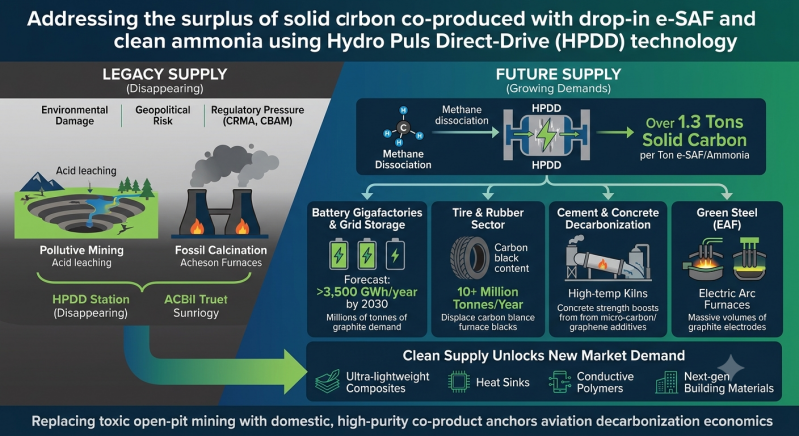
A sharp and valid question came up from an attentive follower: If the Hydro Puls Direct-Drive (HPDD) dissociates methane to co-produce drop-in e-SAF and clean ammonia, it yields over 1.3 tons of solid carbon per ton of aviation fuel.
Won't scaling this flood the market and create a massive surplus?
The short answer: No. It directly solves an acute European and global critical materials deficit.
The energy transition does not demand less carbon, it requires exponentially more high-purity, structural carbon. At the same time, legacy, polluting supply chains are rapidly being phased out.
Legacy Supply is Disappearing
Today, global industry relies on two ecologically damaging sources for graphite and conductive carbon:
* Pollutive Mining: Natural flake graphite relies on open-pit mining and harsh acid leaching (frequently using hydrofluoric acid), leaving a heavy environmental footprint and intense geopolitical concentration.
* Fossil Calcination: Conventional synthetic graphite is baked in Acheson furnaces using coal-tar pitch and petroleum coke at 3,000°C, an energy- and emissions-heavy process under immense pressure from the EU Critical Raw Materials Act (CRMA) and carbon border taxes (CBAM).
As polluting mining and high-emission calcination face regulatory and ESG phase-outs, structural supply is vanishing from global supply chains.
The Massive Industrial Sinks Absorbing the Volume
* Battery Gigafactories & Grid Storage:
While an individual EV battery uses 50–70 kg of graphite, global battery manufacturing targets exceed 3,500 GWh annually by 2030.
That alone creates a multi-million-tonne annual demand for high-purity synthetic graphite that Europe currently imports almost entirely.
* The Tire & Rubber Sector (10+ Million Tonnes/Year):
Tires are 20% to 30% carbon black by weight. Tire makers are urgently hunting for non-fossil, virgin reinforcement carbon to displace furnace blacks derived from heavy residual crude oils.
* Cement & Concrete Decarbonization:
Solid carbon directly displaces imported petcoke in high-temperature calcination kilns. Crucially, micro-carbon and graphene additives boost concrete compressive strength by 20–30%, allowing producers to slash clinker volume, the primary driver of cement's Scope 1 emissions.
* Green Steel (EAF):
Transitioning to Electric Arc Furnaces requires massive volumes of premium graphite electrodes to melt scrap and DRI.
Clean Supply Unlocks New Market Demand.
Reliable, cost-effective synthetic carbon also catalyzes new downstream industries: ultra-lightweight structural composites, heat sinks, conductive polymers, and next-generation building materials.
We aren’t creating a carbon bottleneck; we are replacing toxic open-pit mining with a domestic, high-purity coproduct that anchors the economics of aviation decarbonization.
#EnergyTransition #CriticalRawMaterials #Graphite #eSAF #Decarbonization #CleanTech #CircularEconomy #HPDD